Friday, 19 October 2012

Knit a square photos

Some of these have been posted before, and some of these are new. Many of these have the patterns written for them as part of the Knit A Square A Day project. If the idea of getting your needles clicking to help others sounds good, then get started! Knitting for charity can be wonderful in so many ways. For more information visit here or www.knit-a-square.com .

Flora

Sunset

Red, white and blue

Scrap squares


Pretty pinks

Assorted squares

Squares for baby blanket

J/J/A wool squares

J/J/A squares

More June/ July/ August squares

June/ July/ August squares

Another suprise on my desk this morning!

Colourful squares

Green, blue and purple

It's hip to be square

Squares


Baby blanket

December challenge squares

December challege squares

Saturday, 13 October 2012

Rosette craft: tutorial

A dear friend of mine recently got married, and two weeks before that we had the Hen's night. We had six bridesmaids and they shared most of the work (including Rachael in particular :)  ) but the rosettes were my domain :)
 
These were for the Hen's night, obviously, but could easily be adapted for birthday parties or any other events.


Materials (makes 12):
 
- 2 pieces of craft felt in main colour
- 2 pieces of card in coordinating colour (you could use felt instead if desired)
- Printed circles with event name/ design
- 1 four meter roll of ribbon in main colour (will be some left over)
- 1 four meter roll of ribbon in coordinating colour (will be some left over)
- suitable glue (eg PVA or foam)
- stapler and staples
- scissors
- pencil
 
 
Method:
 
Step 1a:


Using something round (I used a tea cup) trace circles onto the background colour felt. 
 
Step 1b:


Start cutting!
 
Step 2:
 

Using a smaller cup or other round object, draw circles on the card. Again, you could use felt if you want. Get cutting!

Step 3:


Draw or find and print a logo or design for your event. You guessed it, get cutting! (... and yes, I realise that each rosette is one apostrophe short of a grammatically correct event. Don't worry, it bugged me all night.)

Step 4:
Not pictured

Cut both colours of ribbon into 30 cm lengths. It doesn't need to be perfect - a bit longer or shorter is ok.

Step 5:


Staple a piece of ribbon of each colour to the background felt. It should be about 2 - 3 cm from the edge of the disc.

Step 6:


Spread the glue on the background disk of felt, and then glue the cardboard disk on top. Finish off by gluing the design on top.


Step 7:

Put a safety pin through the top and you're all done!


These were for a one night event, so I didn't spend heaps of time finishing the edges of the ribbon, sewing a loop for the pin or anything like that. Mass production was my aim with the cutting, so the edges aren't as smooth as they could be, although it you are a scrapbooker (and I'm not) you could use those cool cuttie- out- punch things to speed things along and fancy them up a bit. I also wish that I had bought ribbon on a roll, not on a flat cart, since it had all the kinks in it.

The bride had a great night and so did everyone else. I hope that these rosettes might make an appearance at your event to make everyone feel special.


Monday, 8 October 2012

Happy World Milksharing Week


I wanted to have this post ready for September 24th - 30th, which is World Milksharing Week but sadly I didn't get it done in time. When I started this blog I said that it would be for my enjoyment, not something that I would stress over, so this post is late since life happened. So, without any further ado...

World Milksharing Week may well be something that you have never heard of before - either milk sharing, or the event. The goal of WMSW is to celebrate milksharing and to promote human milk as the biologically normal nourishment for babies and children.

There are a few things that I want to discuss about donor milk. As usual when I talk about infant feeding and the like, check out my usual disclaimer.

The World Health Organisation recommends four ways that infants should be fed, in priority order depending on the circumstances. Firstly they should be breastfed by their own mother, or if that is not possible then with their mother's own expressed milk. If that is not available, next in line is milk from another healthy lactating mother; either as directly (wet nurse/ cross nursing) or using EBM (donor milk or milk sharing). If milk from another mother isn't available, then infant formula is the next best option.

In our society, we very quickly jump from options 1 and 2, straight to option 4. Option 4 (formula) is still a very valid and necessary option, but I think that option 3 is too often passed over, or mothers don't even know that it exists.

Most people know stories of cross nursing/ wet nursing in the past, and few have a problem with that. It's actually a quite romantic notion in many people's minds. However, if someone feeds another woman's child these days, it's so controversial that it makes the news - seriously. (I'm not saying that what happened in this story was ok or not of that the reaction by the relevant people was or wasn't ok; I have linked to it to show the horror and outrage which often accompanies stories like this.)

Of course, there are many factors when it comes to deciding what is the best thing to do in a particular scenario, and there are as many different reasons for a baby receiving human milk from another mother as there are babies who do. Here's a selection of possible scenarios:

- Baby is left with a friend/ aunty/ babysitter who also happens to be lactating. Mother and babysitter agree beforehand that baby can/ should be breastfed by the babysitter; either in the event that s/he won't take a bottle or the mother may even not leave a bottle in the first place, knowing that human milk with may be safer than EBM (depending on the circumstances) is readily available

- Baby is left with a friend/ aunty/ babysitter who also happens to be lactating. Something happens - a bottle of EBM or formula gets dropped or leaks in a bag, the baby wakes up unexpectedly and won't resettle, baby is very upset and won't calm down or take a bottle, mother gets stuck in a traffic jam and can't get home in time. Since the baby has been left in the babysitter's care, she does what one would expect, and she acts as she sees fit in that circumstance. In the same way that she would put a bandaid on a skinned knee, or give a cuddle after a fright, or to give a time out for naughty behaviour, she decides that the best thing to do is to nurse the baby. She may have the opportunity to ask the mother if this is ok (if they hadn't discussed this before) but she may not. The mother may be uncontactable, or the babysitter may be too concerned with calming the hungry, screaming child in front of her (and probably her own child(ren) is/are there as well if she's lactating) that she acts in what is, in her opinion, the best interests of the child - as the mother who has left her child with her would expect her to do.

- Mother cannot reliably supply her own child with any/ enough human milk. This could be due to a 'production issue' such as Insufficient Glandular Tissue, complications from previous breast surgery or perhaps the mother is taking medications which are incompatible with breastfeeding, such as chemotherapy. (Side note - very few medications are incompatible with breastfeeding, but that's a for another post...) Perhaps she can't provide her child with enough milk due to circumstance - maybe she works away for weeks at a time and needs to pump and dump, maybe she is an exclusive expresser but despite all the best practise she can't keep up with her baby's(ies?) demands. Perhaps the breastfeeding parent is a transgender man who has had breast reduction surgery. In this circumstance, the family may decide that using donor milk (also called milk sharing) is the best option for their family.

Sometimes milks sharing is a one off, occasional thing involving small amounts of milk; sometimes it is ongoing, constant and the main or sole source of nutrition for the baby. Obviously the risks which surround milk sharing need to be considered and it would be foolish and irresponsible not to do so. However; when considering this risk it is important to compare the risks of milk sharing to the risks of formula feeding, the risks of bottle or other feeding device use, the risk of not breastfeeding.

There a few main things to be considered when it comes to risk. Here is an excellent peer reviewed article which addresses many of the key issues in great detail. It is particularly concerned with peer to peer milk sharing versus formula feeding.

To my understanding, milk sharing falls into pretty much three types

- Direct feeding eg cross nursing/ wet nursing

- Peer to peer milk sharing/ donor milk. A mother pumps breastmilk and gives it to another mother, who then feeds it to her baby usually with a bottle and/or a Supplemental Nursing System (SNS). This happens directly and milk is usually sourced/ donated through informal means - friends of friends, advertising on parenting forums/ magazines and/or through organisations such as Human Milk 4 Human Babies.

- More formal donations through milk banks, where mothers donate their milk which is usually then pasteurised and combined with the milk of other mothers. There is usually no contact between the donors and recipients.

Here are some of the arguments that are often expressed with concern to milk sharing.

Safety: How can you give your precious newborn child milk from some random that you met on the internet? How do you know that it's safe, that they don't have diseases or take drugs or that they have sterilised the pump and stored the milk properly?

This is generally the concern with peer to peer milk sharing - very few people seem to have problems with banked milk. Again, this is a topic for another post but many seem more prepared to trust a more formal, organised milk bank with policies and equipment and rules than another mother. As I said this is a whole different discussion, but it's prudent to point out here than banked milk is not available or suitable for many women.

Firstly, very few places have human milk banks. They are found in only a handful of capital cities, so if you don't live there, tough luck. Secondly, milk banks rightly prioritise their limited resources (financial and lactated) to those who need it most - sick and premmie babies. If your baby is healthy (or becomes healthy) then banked milk isn't available to you. Thirdly, banked milk is not suitable to all families. For example, Muslim women believe that it is their religous duty to provide their child with breastmilk and that babies who share milk from the same mother have a sibling bond. They therefore need to know where all of their donated milk has come from, as their baby has formed a sibling bond with that woman's (women's) children and therefore can't get married when they grow up. In a bank situation the milk from many different mothers is mixed together and the recipient cannot trace it back, so that would be unsuitable.

How can you give your precious newborn milk from some random you met on the internet? Perhaps I can look at this another way (and please keep in mind my usual disclaimer).

Instead of looking at formula baby food, perhaps we could look at it this way. Another animal, usually a cow, pumps its breastmilk (uddermilk?) and this milk is donated to/ given to/ stolen by someone else. The milk is taken from this mother (the cow) and is combined with the milk from lots of other mothers (cows). No information is kept about which individuals have contributed to this milk pool, and there is no way to know any of the health information about the donor (cow) mothers or about the age of their babies (calves). No information is known about how the milk is collected, stored and transported. After being transported it is highly processed, modified and supplemented. Very little information is available about these procedures. No information is available about all of the 'randoms' (that is, all of the people who have been involved with the process) to the families of the babies who use this milk. This process is all performed by for profit companies who place infant's health second to their own profits and are therefore professionally involved in misleading mothers. This cross species processed milk is then widely available for sale as one for two culturally normal options for the feeding of previous newborns.

When you consider formula in this light, does donor milk really look so strange? Donor milk involves a human mother willingly donating (not selling) human milk to another baby who, for whatever reason, is unable to receive his/her mother's own breastmilk exclusively. The mother(s) are (or become) known to the receiving family. They know where they live, the age of their babies, that their babies are human. Generally receiving mothers ask for blood tests and medical histories about the donor mother, as well as information about any medications, diet and alcohol consumption. They mothers generally discuss milk collection and storage procedures. Yes, the receiving families are trusting the honesty of the donor mothers that they are doing what they say - but remember that formula using families are trusting the formula companies for the same thing, which is by no means reliable. (Melamine anyone? Salespeople dressed up as nurses with quotas to fill? Goodnight milk?) I admit that when I first heard of donor milk from people you don't know, I was dubious about it; however, when you consider how much we don't know about formula (and consider acceptable) then I think it paints donor milk in another light.

Remember that all things in life are about assessing the risks of taking a particular form of action (or not taking it). I again link to this peer reviewed article which details a lot of the issues.

This is nutso extreme. Yes, breast is best but you gave it your best shot. Come on - you have IGT, you are one of the women who genuinely can't breastfeed, aren't you the type of person who is allowed to use formula totally guilt free? Isn't driving around to other women's houses to pick up milk and check blood test results a little extreme?

I would also like to point out something that a friend with IGT said to me. One of the biggest criticisms of those who talk about the risks of formula feeding or the benefits of breastfeeding is that this shouldn't be done because it makes mothers who can't or don't breastfeed 'feel guilty'. However, the marginalisation of mothers who choose to use donor milk and the scaremongering around the risks donor milk are extreme and in my opinion shameful.

Again, 'extreme' is a relative position. Feeding your baby purchased, highly processed milk of another species when there is same-species milk available may be considered 'nutso extreme' too.

It has been with mixed emotions that I have noticed more media coverage about donor milk, particularly peer to peer milk sharing. Firstly, the coverage has in general been pretty unimpressive and full of scaremongering. However, the fact that these articles are finding their way into mainstream tabloid newspapers itself seems like a good step to me, because it is normalising the use of human milk.

I also want to thank three groups of people here. Firstly, I would like to thank the mothers who willingly donate their milk to other precious children who need it. Secondly, I would like to thank those who are advocating for milk sharing, and thirdly I would like to thank all those who support the donors and advocates.

I encourage mothers and families to be aware and informed of the risks and benefits of their chosen way of feeding and how it relates to their particular circumstances, and the risks and benefits of avoiding certain ways of feeding.

Yay for milk!

Linked
Linked

Saturday, 6 October 2012

Simple toddler dress -free tutorial

This too cute dress is very easy to make, since we shortcut a bit with the t shirt!


Materials:

- Small amount of fabric - 1/2 metre if getting it cut with plently left over, or a fat quarter would be enough too.
- T shirt (I used a size two)
- Thread
- Measuring tape
- Sewing machine
- Overlocker optional.


There are a few modifications that I would make next time, but otherwise it worked well.

Procedure:

Step 1:

To start with measure the bottom of the t shirt. The fabric skirt will be twice as long, so multiply this number by four. (It would be really bad if you were a maths teacher, and you only multiplied this number by two, and cut the fabric half as long as it would have been.) The yellow shirt that I used was 31 cm wide, so my fabric should have been 124cm long plus a little bit more for seams (this is not an exact project, so a bit bigger or smaller is ok.)

Step 2:


Cut the fabric as wide as you need it (four times the width of the shirt) and as long as you want it. I cut it 20cm + seam allowance, which was probably too much. (I put a generous hem on it and will probably take it up a bit more.

Don't cut it in two pieces like I did accidentally. Luckily it was a forgiving fabric and I ws able to stitch it back together. If you were cutting from a fat quarter (rather than 112cm wide fabric cut by the metre) then you may need to stitch the two pieces together anyway.

Step 3:

With right sides together pin then stitch the fabric into one long loop. I used the overlocker, but you could just use a regular sewing machine. You should now have one long loop, twice the width of your shirt.


Step 4:


Sort out the edges of the loop. I put a rolled hem for the bottom (which I ended up changing) and then just overlocked the top edge so it wouldn't be raw.

Step 5 (not pictured):
Mark with a dressmaker's pencil or similar four evenly spaced marks on the loop. That is, put a mark where you want the two sides to sit and the front centre and back centre. This is to make sure that your gather is even (or even-ish)

Step 6:


Set your sewing machine to very large, loose stitches, about 3cm from the top edge. Stitch all the way around the loop. This thread will be removed later so no need to fuss about colour matching or being super straight and perfect. Do not tie off at the beginning or the end.

Step 7:


Pull the thread through so that the skirt gathers up. You want to make the skirt about half it's size; if in doubt go smaller since it's easier to let it out than it is to gather it in. If you do need to gather it in again, pull on the stitching to tighten it up.

Step 8:


Pin the skirt to the shirt. The skirt should be upside down an wrong side out; the shirt should be right side out. To make sure that you have an even gather, only use four pins initially - pin the marks from Step 5 to the side seams and front and back centre of the shirt. For a toddler sized dress, this will be enough pins.

In hindsight, I wish that I had cut the hem off the shirt, or sewn the skirt above it. I may yet go back and fix this, but I won't get another sewing day for months so I wanted to post this before then!

Step 7:


Stitch the skirt to the shirt, smoothing down the gather as you go. You may need to adjust the gather; be guided by the four pins, and estimate an even gather between every two pins.

I'm not sure how this would go using an overlocker; I will try that next. If you did do this, then you could skip overlocking the top of the skirt in Step 4.

When you have finished sewing the skirt to the shirt, remove the gather thread.

Final steps:

Turn right side out and have a look at the dress. I ended up taking the dress up with a 1.5 inch hem. Since I did the rolled hem underneath, I'm hoping that next year when Chubs is taller I can just rip out the extra hem and I won't need to re-hem underneath.


I'm still not happy with the hem join here. Also keep in mind that I haven't ironed it. I haven't really decided what to do, so I will keep you posted. Chubs is wearing this dress to a birthday party at the playground tomorrow, so that should give it a good 'test run' too.

Final final step: Find a too-cute toddler to wear it!


I hope this tutorial has been useful for you; I plan to update this when I've had a chance to make a few more and iron out the kinks. (Get it, since I didn't iron... oh well.) Please let me know what you think in the comments!

Linked and linked

Sunday, 9 September 2012

A Kilo of Kindness: Update 4 - 9


Some more things to update the Kilo of Kindness list.

4. 3LWs said: Dropping off 3 meals, bread, milk, chocolate biscuits and presents after I had DS2?
Surely those count, they made us feel loved!!
5. Mooki said: after I had DS the forum girls arranged homecooked meals to be delivered for the week,we did the same for nightowl and will be doing the same for Loli and Andy too

6. NH said: I think I could nearly fill your kilo! People are truly wonderful. I will work on a list! NH also got send a little package of goodies for her family and for her daughter when she wasn't well.

7. AP said: I had severe anxiety this week. I had friends drop over food and take my son out so I could sleep. I also received messages of support from some lovely forumites. I feel privileged to be a part of this community.

I will think of an act of kindness that I can return to the world.

I really think that most people on the world are capable of massive kindness when required.


8. and 9.Chubs and I have both been sick, and my sister has helped out with some extra babysitting. Thanks Aunty K!


Please keep your kindness ideas coming in - let me know by leaving a comment here (or on any post) or by emailing a_kilo_of_kindness at live dot com dot au . I would love to attribute names/ usernames but I'm happy to leave it as anonymous if you would like.

Tuesday, 4 September 2012

Plain packaging for formula?

Before I start this post proper, I would like to start this post with what I usually say when I talk about formula advertising. This is in no way, at all, in any way, a critism of how parents feed their children.

Yes, I'm a big breastfeeding fan, however, how someone else chooses to feed his/ her child is not my concern. Yes, I think that breastfeeding (or not) has public health implications, but so do many other things. Someone may write a blog post explaining why exercising regularly is great for the health of your family, and what the risks of not exercising are. Someone else may tell me about their experiences with in home/ family day care, and about how it meets the needs of small children better than other forms of care. Someone else may write a blog post about how car manufacturers encourage dangerous driving by making speeding look attractive, which may encourage reckless driving behaviour. None of these things mean that I am a bad person because I don't go to the gym, I send my daughter to a daycare centre and I have a red car, nor do I think that that is what these hypothetical posts intended.

This post is not several things too. It is not anti formula. It is not passing judgment on how someone feeds their child, it is not meant to be advice, it is not 'telling off' formula feeders. Kick me out of the "yay boobies" club if needed, but I don't think that using formula is something which demands a defence or explanation to random strangers or society at large.

This post is several things - it is a brief commentary on unethical advertising, it is an attempt to raise awareness about these tactics and it is an act of advocacy. With this post, perhaps one more seed of change will be sown. It may take many years, probably decades, but perhaps this post can be one tiny part - though a part none the less - of this change.

Now, for the post proper...

Recently a landmark decision was made in the Australian High Court which is of international significance. (Before I go on, I am in no way a legal expert beyond a fondness for big words, so please forgive my lack of understanding of detail and feel free to correct me if required.) The Australian Government introduced legislation which would force cigarette packets to have plain packaging. Plain packets, no logos or pictures (except for the graphic warning label) or colours or fonts - just a plain packet with the brand name printed and the information about the type and number of cigarettes and so on. It is my understanding (and again, my legalese is very minimal) that the tobacco companies fought against this legislation on the basis that it infringed on their intellectual property rights and that such legislation was not permitted under the constitution.

The good part? The tobacco companies lost. The best part? They had to pay the Government's legal costs, too.

It got me thinking about unethical advertising, and in particular about how similar the sneaky techniques of tobacco companies are to formula companies.

Do you remember cigarette ads like these?


Nope, me either. That is, I remember seeing them in books and blog posts, but as items relegated to the dark ages of pop culture history. I think how amusing it is that cigarettes - perhaps the worst health invention ever - were being advertised as healthy. The worst aspect of the health issue is the respiratory system, and that's the very thing that the advertisments were saying how great cigarettes are - smooth on the throat. Throw in some puffed up professional expert endorsements (like physicians and scientists) and a good drag of pseudo-science and you have an addictive and attractive advertising campaign.

At least, I think it's amusing, until I remember that this actually happened to real, actual people. It's not so amusing, then. It still seems far fetched, though. As a child of the 80s I can't imagine that people actually believed the ads that said that cigarettes were healthy.

Of course, I realise that times change. The high court decision about the tobacco advertising got me thinking - in fifty years time, will the idea that formula was marketed as a health product seem unbelievable? I hope so.

When I was a child the idea that cigarettes were health was long gone of course, although cigarette advertising wasn't. I can't remember ever seeing any cigarette ads on TV, but I remember seeing lots of logos on billboards and lots of sports sponsors. I recall the Windfield Cup and logos adorning atheltes and sporting fields alike. I saw a story on TV about a couple (I think - I was small and it was a long time ago) who ran an informal coast guard service or something; paid for by advertising 'Winfield' in glorious red and white on the side of the boat. The couple were concerned that the (then) soon to be introduced laws banning cigarette advertising would mean that they would lose their funding for this community service. There was an advertising campaign a few years ago against plain packaging - poor, hard working corner store owners couldn't afford to have reduced (cigarette) sales so we should get plain packaging.

None the less, cigarette ads were banned, and now we have this landmark plain packaging. I think it's a huge step in the right direction. If one of the claims against plain packaging "it won't work so why do it" was true, then why were the tobacco companies so worried that they went to the extreme cost of mounting a high court claim? If they weren't really, really worried, then why bother? Now, back to formula. Some would suggested that likening formula advertising to tobacco advertising is ove the top, but I don't think so. The issues of advertising is even more of an issue with formula - formula is a legimate product which is very much needed. Yes, only by a small number of people in a small number of circumstances, but needed none the less. One could reasonably argue that cigarettes could or should be banned completely; not so for formula. As even the rigid breastfeeding supports will claim; when a baby is hungry, he needs to be fed. When the first three options (breastfeeding, expressed milk from mother, expressed milk from another mother) are not available/ practical/ possible, then formula is essential, life saving and vital. The amount of formula sold is obviously well above the amount that would be needed to meet those cases, and I believe that unethical advertising has a lot to do with that. The WHO Code states that no advertising should occur to parents or the general public, including information services such as baby clubs. However, despite Australia being a signatory much of the Code is not enforced under Australian law. A great deal of advertising also sneaks in as permitted through the gaping wide loophole that is toddler formula. Everywhere these days, the 'health benefits' of formula are advertised. The token 'breast is best, consult a health professional' is there - but not on the toddler formula, since it doesn't have to be. Some pseudo-science and a few expert endorsements and it's like we're looking at a 50s cigarette ad. "NAN Pro 3 with Bifidus BL is also sucrose free which is great news for little teeth!" here Similac® Advance®
Give your baby complete nutrition for the first year
Similac Advance has EarlyShield® and is designed to support your baby’s developing immune system, brain and eyes, and strong bones. here Aptamil® Gold+ 1 Infant Formula nutritionally supports the developing immune system. A well-supported immune system is important for your baby’s growth and development. here
 
"protect" "premium" "gold"
"Gold +" "premium" "Immunocare"
What is ImmunocareTM? Well, I've got no idea. It's trademarked, and it comes on a shiny gold shield, subconsciously protecting my child from all those nasty daycare germs, but how it actually works or what's in it? No idea. Breastfeeding support the child's immune system by helping the child to build passive immunity to diseases that the mother has come in contact with when the mother's antibodies pass in her milk into the baby. Stuffed it I know what ImmunocareTM does."Nutritionally supports the immune system" - so, it's about nutrition, not the immune system at all. Hmmm...
 
The High Court decision got me thinking about plain packaging formula. Of course, all formula advertising would need to be banned first (including retailers and toddler milk) - and it would take much, much greater legal minds than mine to tell me if the High Court decision could set a precedent in any way for a plain packaging formula push.
 
Is it too much to hope that the immune-caring benefit of formula eventually goes the way of cigarettes which soothe your cough? The health of our future depends on it.

Linked

National Science Week

I just realised that this post was sitting in my drafts. Sorry, it's a bit late now but hopefully it's still funny!

As National Science Week draws to a close, I would like to share with you one of Chubs' outfits from this week.

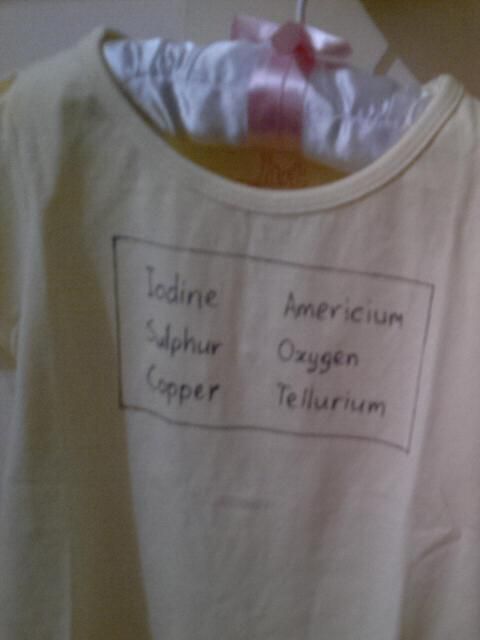
Anyone looking for a geeky baby shirt idea, here you go:


For those of you who aren't so nerdy, the symbols of the elements iodine, americium, sulphur, oxygen, copper and tellurium spell

     I Am SO CuTe

If you're giggling by now, then you probably didn't need the explanation, and I suspect that you and I are the same type of nerd.

If you did need the explanation, then you are probably groaning and rolling your eyes now. It's ok, I'm used to it :D


I also did some volcanoes (ie, vinegar and bicarb) with my very helpful and enthusiastic scientists-in-training at playgroup and at Chubs' daycare (with the big kids.) Very simple but lots of fun and dead easy to clean up! Yay for science!
Related Posts Plugin for WordPress, Blogger...