Showing posts with label health. Show all posts

Wednesday, 13 November 2013

Wholemeal pasta substitution


A simple switch which we're trying to do more often is to have wholemeal pasta instead of white. I do miss the taste of white pasta and still get it occasionally, but the brown pasta is definitely an easy, healthier substitute.

Chubs will only eat pasta occasionally. 'Rainbows', as picture above, are a sure hit every time. Win.

Wednesday, 4 September 2013

Exercise log - August

Well, it has begun.

August wasn't great, but I'm going to keep going. I'm definitely taking the view that 'anything is better than nothing'.

Diet: I've been up-ing the salads, although having fresh salads available all the time isn't always do-able. However, spinach + some veggies + tin of tuna is becoming my go-to lunch, ahead of toast or a sandwich. I'm still falling back on a sandwich for when there's no spinach, since I can freeze bread so I don't run out. I've been trying to have more protein for breakfast, for example one piece of toast with a boiled egg, rather than two pieces of toast. While Dear Husband was away, protein shakes were a back up breakfast (and lunch) for me.

Sugar's been a problem. I'm trying to avoid it, but of course all those yummy bring-a-plate morning teas are still so prevalent. At work we made a Periodic Table out of cupcakes for National Science Week - that was a whole lot of cakes to ice when I should have been eating a healthy morning tea. I'd not eaten breakfast due to daycare drop off dramas and was literally shaking, so a cupcake for morning tea it was. However, I will continue to try to eat well and not be thrown off by the 'excitements' that life throws.


Exercise: Got off to a good start, then stalled. The plan so far has been for Dear Husband to play at the park with Chubs, while I run around the park. Dramas erupted a few times with a cranky bub, and this plan didn't work while Dear Husband was away. I did fit in a massive walk around the botanical gardens which I didn't put on the log.

I had thought of exercise options for when Chubs would be my reponsibility, but none worked out. It's a 10 and a half hour day for Chubs at daycare when DH is away, so I don't think it's fair to leave her there longer. Even if I did, I'm too flogged and by the time I got changed into exercise clothes etc I would only have time for a ten minute run before I would have to pick her up before daycare closes, so it's just not worth it. Another possible option may have been to have dropped Chubs off at Nan's house for a play and for me to go for a ride on Nan's bike, but Nan was either at work or away herself. I had a few extra days of work and some pre-wedding events over the last few weeks as well, which cut down my options both as my time was tighter, and I'd used up a lot of babysitting from others that I couldn't ask them to babysit more - both for their sake and for Chubs' sake.

However, the plan is to continue. I will just keep trying to get done what I can. Dear Husband is home, so hopefully we can get back on track. I'm a bit dubious about how September will pan out - I've got a lot of extra work plus a wedding and several family events, so it's not looking much better than August, however the plan continues.

I've roped in a friend to keep me accountable, so hopefully things will keep on track!

Saturday, 24 August 2013

Fabulous Croquet

I played croquet this afternoon with some long time girlfriends. It was truly lovely.

 
Chubs was having some Daddy time, and we had some yummy food, lovely conversation and great weather.

 
My croquet skills were moderate for a beginner (ie pretty rubbish...) The club had a staff member who walked around with us telling us what to do and what the rules were which helped a lot! 
 
 
Everything is better with cupcakes 
 

Sadly a lot of my photos didn't work out and I can't seem to upload them. :(   It was a lovely afternoon though - highly recommended. My best wishes to my dear friend xx

Sunday, 18 August 2013

Exercise, diet and weight loss

So, about two weeks ago, I found out that I'm overweight. According to my BMI of 26.9...

Once you have measured your BMI, you can determine your healthy weight range. If your BMI is:
- Under 18.5 - you are very underweight and possibly malnourished.
- 18.5 to 24.9 - you have a healthy weight range for young and middle-aged adults.
- 25.0 to 29.9 - you are overweight
- Over 30 - you are obese.

I've been steadily putting on weight over the last twelve years since I've left school. I've averaged about two kilograms a year, and have slowly gone from a size 8 to a 14. I did lose a lost of weight when I was pregnant however, so my gain-per-year rate is actually higher than two.

Contributing factors which I can see include
- a less than stellar diet (not awful, but room for improvement)
- no exercise
- motherhood
- hormones/medications
- not being seventeen any more

My diet is ok, but not great. We try to eat healthy foods, but I probably eat too many carbs and too much cheese. We don't tend to buy lollies, chocolate, soft drink and the like but when things get busy I will eat whatever is shelf stable and quick (such as cheese on toast, or raiding the chocolate drawer at work.) I try to keep portions down, but this is perhaps something that I need to work harder on.

I currently do very little exercise. I used to go to the gym before Chubs was born, but it just became too hard after she was here. They do have a creche at the gym, but none of us were comfortable leaving her there. There wasn't anything wrong with the creche, however Chubs was always more comfortable with people whom she knew. The expense when I wasn't attending was guilt inducing and I didn't really feel that it was working before Chubs, let alone after. I cancelled my membership when I finished my maternity leave.

Motherhood itself has probably had a large effect too. Whilst pregnancy for me wiped of 12 kilos and the 500 calories a day that breastfeeding uses were very helpful, the craziness and constant demands of life with a little one mean that often meals are easy, quick and shelf stable - more cheese on toast. If we're out during the day (which we often are) we will stop at a cafe for a coffee/ bubbachino and a little something to break up the day and give little legs a rest. One thing that we do a lot is attend mothers' groups and go on playdates. I was talking to Chubs about a friend (from mothers' group) that we were ging to visit. When I asked her what she was going to play with her friend she told me 'babies and coffee and playgrounds' - which shows that she knows her from mothers' group! Everyone brings a plate, and while we often have fruit, veggies sticks and other healthy options, the cake, chocolate biccies and other yummy yummy goodness are always in plentiful supply, as they are at birthday parties.

I've been on various medications that have had an effect on my mass (I think) but it's always hard to know as I can't exactly run a controlled test without a time machine. Dysmenohhorea, possible PCOS and possible gestitational diabetes haven't helped with trying to work out what is going on either. While 500 - 600 calories a day is the commonly quote figure for exclusive breastfeeding, I'm yet to find any information on the calorie demand of breastfeeding a toddler.

So, where to from here? I have decided that I need to do something. There are many reasons why diet and exercise won't work for me, but I need to just work towards 'better'. I have taken the approach that anything is better than nothing. In the last fortnight I have started to think about and implement changes in my diet, and I have done two exercise sessions so far.

I've been quite open in this post, since I want to share my journey. By following the example of others, I have realised that I need to think outside the box and look for possible solutions rather than just seeing roadblocks.

Coming soon:
Exercise changes
Diet changes

Thursday, 16 May 2013

Why formula is not poison


I came across this link recently, and I believe this mother makes an excellent point.

Formula is not white poison. It's not heroin. It's not the enemy.

Can I say that again loud and clear. FORMULA IS NOT THE ENEMY.

Formula is a breastmilk substitute. A substitute, a replacement, an alternative. Even the frigging WHO Code refers to ‘breast milk substitutes’. There’s a reason it’s not called the “International Code of Marketing of Baby Poisons”.

If I can’t teach a class, they get a relief teach in as a substitute. Not a criminal, but a substitute teacher. If I don’t have a bib when we’re out, I can substitute with a napkin. Not with a sheet of asbestos, but with an acceptable alternative. If the route to work is closed due to traffic, I can go the long way round. Not give up on work entirely, but find a different route.

Yes, formula is not as good as breastmilk. Yes, it carries risks (but so do all methods of feeding). Yes, donor milk is often (but not always) a better alternative. But formula is an acceptable substitute.

Existing readers of my blog will know that I have some pretty strong views about the unethical advertising of formula, but that does not mean that the product is bad. I think that a lot of the marketing techniques of pharmaceutical companies are pretty abysmal (and in many ways similar to formula companies) but that doesn’t mean that I think medications are evil. Actually, medications are very similar to formula – in some cases they are essential and lifesaving, and in many cases they are ‘just’ helpful and convenient. Medications, like formula, are susceptible to being used inappropriately and their use needs to be carefully managed to minimise the risks – but they aren’t the cause of everything bad in the world. They are a GOOD THINGS - sometimes used inappropriately and dangerously (often fuel on by dodgy marketing) – but still fundamentally a GOOD THING.

Friday, 4 January 2013

Operation Sleep Rule Change - abandoned

Operation Sleep Rule Change was about getting some more space in our bed in a gentle, respectful way. If you missed the first post, it's here. In summary, we were aiming to get Chubs to sleep in her cot until 3am, and then to come into out bed. Sometimes she does this on her own - the last few nights she's slept in her cot until 4:30am, but it's certainly not consistent.

It was working for a while, however things started to fall apart. Chubs was sick a lot, Dear Husband was away so I was flying solo and Chubs started waking more frequently and needing more settling. Over the Christmas break we had two trips away for over a week each which meant a break in routine.

Perhaps most importantly, the plan (that Dear Husband and I would get more sleep) wasn't working. In August I said: To be honest, Dear Husband and I aren't feeling as wonderfully well rested as I was hoping. As I supsected (but was dearly hoping I was wrong) I think at lot of our constant state of exhaustion is more to do with having a vibrant, beautiful, bouncy toddler than a cosleeping one. To resettle Chubs in the middle of the night when she is in our bed is much, much easier that getting up to feed/ cuddle/ rock her in the cot. I'm sure we all get much more sleep when she's in with us. Often Dear Husband and I don't know who brough her into bed with us or what time it was now that we aren't trying to change it.

The final straw for me was one night when she wouldn't settle in her cot. I felt so mean. I was trying to settle my young child in a cage in a room all on her own so that I could go into a separate room, and not only share that room with another loved one, but actually share a bed! Why should I, as a grown adult who knows all about object permanence and how to ask for help clearly, get to share a bed with someone I love and at the same time expect my baby to sleep on her own in a cot in a separate room? She clearly needs the comfort and closeness - this is normal toddler behaviour.

Yes, we still get a lot of diagonal starfishing and bed angels. There's nothing glamorous about waking up with one foot in your ear and the other in your back. The problems that caused us to seek Operations Sleep Rule Change still exist. However, it now seems that these things aren't going to be fixed by having me stand by Chubs' cot several times a night.

I don't regret bringing Chubs into bed with us when she was little and teaching her 'bad habits'. I don't regret feeding her to sleep, nor 'training' her to sleep through the night at weeks or months old. This is all normal behaviour. She's a happy, healthy, thriving little girl. She won't always be in bed with us, she won't always feed through the night, she won't always want cuddles during the night - well at least not from Mum and Dad anyway.

I've never heard anyone say "I wish that I had cuddled my child less when she was little". So, for the time being at least, we will continue to love, cuddle, feed, rock and sleep togetherin the big bed - just where everyone wants to be. Even if it is a bit crowded.

Monday, 8 October 2012

Happy World Milksharing Week


I wanted to have this post ready for September 24th - 30th, which is World Milksharing Week but sadly I didn't get it done in time. When I started this blog I said that it would be for my enjoyment, not something that I would stress over, so this post is late since life happened. So, without any further ado...

World Milksharing Week may well be something that you have never heard of before - either milk sharing, or the event. The goal of WMSW is to celebrate milksharing and to promote human milk as the biologically normal nourishment for babies and children.

There are a few things that I want to discuss about donor milk. As usual when I talk about infant feeding and the like, check out my usual disclaimer.

The World Health Organisation recommends four ways that infants should be fed, in priority order depending on the circumstances. Firstly they should be breastfed by their own mother, or if that is not possible then with their mother's own expressed milk. If that is not available, next in line is milk from another healthy lactating mother; either as directly (wet nurse/ cross nursing) or using EBM (donor milk or milk sharing). If milk from another mother isn't available, then infant formula is the next best option.

In our society, we very quickly jump from options 1 and 2, straight to option 4. Option 4 (formula) is still a very valid and necessary option, but I think that option 3 is too often passed over, or mothers don't even know that it exists.

Most people know stories of cross nursing/ wet nursing in the past, and few have a problem with that. It's actually a quite romantic notion in many people's minds. However, if someone feeds another woman's child these days, it's so controversial that it makes the news - seriously. (I'm not saying that what happened in this story was ok or not of that the reaction by the relevant people was or wasn't ok; I have linked to it to show the horror and outrage which often accompanies stories like this.)

Of course, there are many factors when it comes to deciding what is the best thing to do in a particular scenario, and there are as many different reasons for a baby receiving human milk from another mother as there are babies who do. Here's a selection of possible scenarios:

- Baby is left with a friend/ aunty/ babysitter who also happens to be lactating. Mother and babysitter agree beforehand that baby can/ should be breastfed by the babysitter; either in the event that s/he won't take a bottle or the mother may even not leave a bottle in the first place, knowing that human milk with may be safer than EBM (depending on the circumstances) is readily available

- Baby is left with a friend/ aunty/ babysitter who also happens to be lactating. Something happens - a bottle of EBM or formula gets dropped or leaks in a bag, the baby wakes up unexpectedly and won't resettle, baby is very upset and won't calm down or take a bottle, mother gets stuck in a traffic jam and can't get home in time. Since the baby has been left in the babysitter's care, she does what one would expect, and she acts as she sees fit in that circumstance. In the same way that she would put a bandaid on a skinned knee, or give a cuddle after a fright, or to give a time out for naughty behaviour, she decides that the best thing to do is to nurse the baby. She may have the opportunity to ask the mother if this is ok (if they hadn't discussed this before) but she may not. The mother may be uncontactable, or the babysitter may be too concerned with calming the hungry, screaming child in front of her (and probably her own child(ren) is/are there as well if she's lactating) that she acts in what is, in her opinion, the best interests of the child - as the mother who has left her child with her would expect her to do.

- Mother cannot reliably supply her own child with any/ enough human milk. This could be due to a 'production issue' such as Insufficient Glandular Tissue, complications from previous breast surgery or perhaps the mother is taking medications which are incompatible with breastfeeding, such as chemotherapy. (Side note - very few medications are incompatible with breastfeeding, but that's a for another post...) Perhaps she can't provide her child with enough milk due to circumstance - maybe she works away for weeks at a time and needs to pump and dump, maybe she is an exclusive expresser but despite all the best practise she can't keep up with her baby's(ies?) demands. Perhaps the breastfeeding parent is a transgender man who has had breast reduction surgery. In this circumstance, the family may decide that using donor milk (also called milk sharing) is the best option for their family.

Sometimes milks sharing is a one off, occasional thing involving small amounts of milk; sometimes it is ongoing, constant and the main or sole source of nutrition for the baby. Obviously the risks which surround milk sharing need to be considered and it would be foolish and irresponsible not to do so. However; when considering this risk it is important to compare the risks of milk sharing to the risks of formula feeding, the risks of bottle or other feeding device use, the risk of not breastfeeding.

There a few main things to be considered when it comes to risk. Here is an excellent peer reviewed article which addresses many of the key issues in great detail. It is particularly concerned with peer to peer milk sharing versus formula feeding.

To my understanding, milk sharing falls into pretty much three types

- Direct feeding eg cross nursing/ wet nursing

- Peer to peer milk sharing/ donor milk. A mother pumps breastmilk and gives it to another mother, who then feeds it to her baby usually with a bottle and/or a Supplemental Nursing System (SNS). This happens directly and milk is usually sourced/ donated through informal means - friends of friends, advertising on parenting forums/ magazines and/or through organisations such as Human Milk 4 Human Babies.

- More formal donations through milk banks, where mothers donate their milk which is usually then pasteurised and combined with the milk of other mothers. There is usually no contact between the donors and recipients.

Here are some of the arguments that are often expressed with concern to milk sharing.

Safety: How can you give your precious newborn child milk from some random that you met on the internet? How do you know that it's safe, that they don't have diseases or take drugs or that they have sterilised the pump and stored the milk properly?

This is generally the concern with peer to peer milk sharing - very few people seem to have problems with banked milk. Again, this is a topic for another post but many seem more prepared to trust a more formal, organised milk bank with policies and equipment and rules than another mother. As I said this is a whole different discussion, but it's prudent to point out here than banked milk is not available or suitable for many women.

Firstly, very few places have human milk banks. They are found in only a handful of capital cities, so if you don't live there, tough luck. Secondly, milk banks rightly prioritise their limited resources (financial and lactated) to those who need it most - sick and premmie babies. If your baby is healthy (or becomes healthy) then banked milk isn't available to you. Thirdly, banked milk is not suitable to all families. For example, Muslim women believe that it is their religous duty to provide their child with breastmilk and that babies who share milk from the same mother have a sibling bond. They therefore need to know where all of their donated milk has come from, as their baby has formed a sibling bond with that woman's (women's) children and therefore can't get married when they grow up. In a bank situation the milk from many different mothers is mixed together and the recipient cannot trace it back, so that would be unsuitable.

How can you give your precious newborn milk from some random you met on the internet? Perhaps I can look at this another way (and please keep in mind my usual disclaimer).

Instead of looking at formula baby food, perhaps we could look at it this way. Another animal, usually a cow, pumps its breastmilk (uddermilk?) and this milk is donated to/ given to/ stolen by someone else. The milk is taken from this mother (the cow) and is combined with the milk from lots of other mothers (cows). No information is kept about which individuals have contributed to this milk pool, and there is no way to know any of the health information about the donor (cow) mothers or about the age of their babies (calves). No information is known about how the milk is collected, stored and transported. After being transported it is highly processed, modified and supplemented. Very little information is available about these procedures. No information is available about all of the 'randoms' (that is, all of the people who have been involved with the process) to the families of the babies who use this milk. This process is all performed by for profit companies who place infant's health second to their own profits and are therefore professionally involved in misleading mothers. This cross species processed milk is then widely available for sale as one for two culturally normal options for the feeding of previous newborns.

When you consider formula in this light, does donor milk really look so strange? Donor milk involves a human mother willingly donating (not selling) human milk to another baby who, for whatever reason, is unable to receive his/her mother's own breastmilk exclusively. The mother(s) are (or become) known to the receiving family. They know where they live, the age of their babies, that their babies are human. Generally receiving mothers ask for blood tests and medical histories about the donor mother, as well as information about any medications, diet and alcohol consumption. They mothers generally discuss milk collection and storage procedures. Yes, the receiving families are trusting the honesty of the donor mothers that they are doing what they say - but remember that formula using families are trusting the formula companies for the same thing, which is by no means reliable. (Melamine anyone? Salespeople dressed up as nurses with quotas to fill? Goodnight milk?) I admit that when I first heard of donor milk from people you don't know, I was dubious about it; however, when you consider how much we don't know about formula (and consider acceptable) then I think it paints donor milk in another light.

Remember that all things in life are about assessing the risks of taking a particular form of action (or not taking it). I again link to this peer reviewed article which details a lot of the issues.

This is nutso extreme. Yes, breast is best but you gave it your best shot. Come on - you have IGT, you are one of the women who genuinely can't breastfeed, aren't you the type of person who is allowed to use formula totally guilt free? Isn't driving around to other women's houses to pick up milk and check blood test results a little extreme?

I would also like to point out something that a friend with IGT said to me. One of the biggest criticisms of those who talk about the risks of formula feeding or the benefits of breastfeeding is that this shouldn't be done because it makes mothers who can't or don't breastfeed 'feel guilty'. However, the marginalisation of mothers who choose to use donor milk and the scaremongering around the risks donor milk are extreme and in my opinion shameful.

Again, 'extreme' is a relative position. Feeding your baby purchased, highly processed milk of another species when there is same-species milk available may be considered 'nutso extreme' too.

It has been with mixed emotions that I have noticed more media coverage about donor milk, particularly peer to peer milk sharing. Firstly, the coverage has in general been pretty unimpressive and full of scaremongering. However, the fact that these articles are finding their way into mainstream tabloid newspapers itself seems like a good step to me, because it is normalising the use of human milk.

I also want to thank three groups of people here. Firstly, I would like to thank the mothers who willingly donate their milk to other precious children who need it. Secondly, I would like to thank those who are advocating for milk sharing, and thirdly I would like to thank all those who support the donors and advocates.

I encourage mothers and families to be aware and informed of the risks and benefits of their chosen way of feeding and how it relates to their particular circumstances, and the risks and benefits of avoiding certain ways of feeding.

Yay for milk!

Linked
Linked

Wednesday, 4 July 2012

More WHO Code breaches - the sneaky tricks of advertisers

I would like to start this post repeating what I have said before. The International Code on the Marketing of Breast-milk Substitutes (the WHO Code) is about making sure that formula, bottles etc are marketed in a way which is safe and appropriate. It is not 'anti-formula'. Australia has agreed to follow the WHO Code, but only a portion of it is covered by law. By highlighting breaches of the WHO Code I am not making comment about one's choice to use formula or to use a dummy or to breastfeed or to introduce solids at x months or anything. It is about exposing the deceitful and unethical advertising tricks of large companies. Many of the sneaky advertising tricks used by formula companies are also used by tobacco companies. I feel that it is responsible to expose these tactics.
I went to a baby expo with Chubs recently. Actually, we went twice. Why did I decide to go to such a consumer-fest when I had no intention of spending money? Well, I was keen for free samples of nappies et cetera, and there were free kiddy concerts and activities. I had a free entry ticket (door price $14) so for the cost of a train fare in and back it was good for a rainy day.

I knew what I was going to find, and sure enough - WHO Code breaches as far as the eye can see. In Australia formula for under 12 months cannot be advertised, however the formula companies found their way around that, as ever.

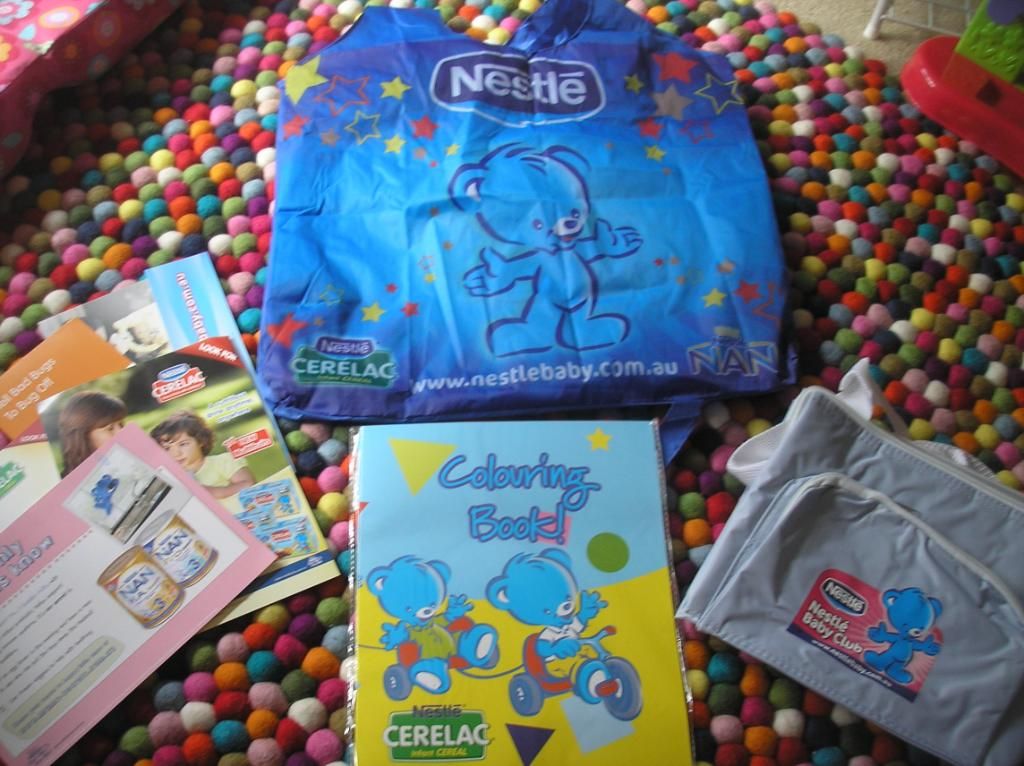
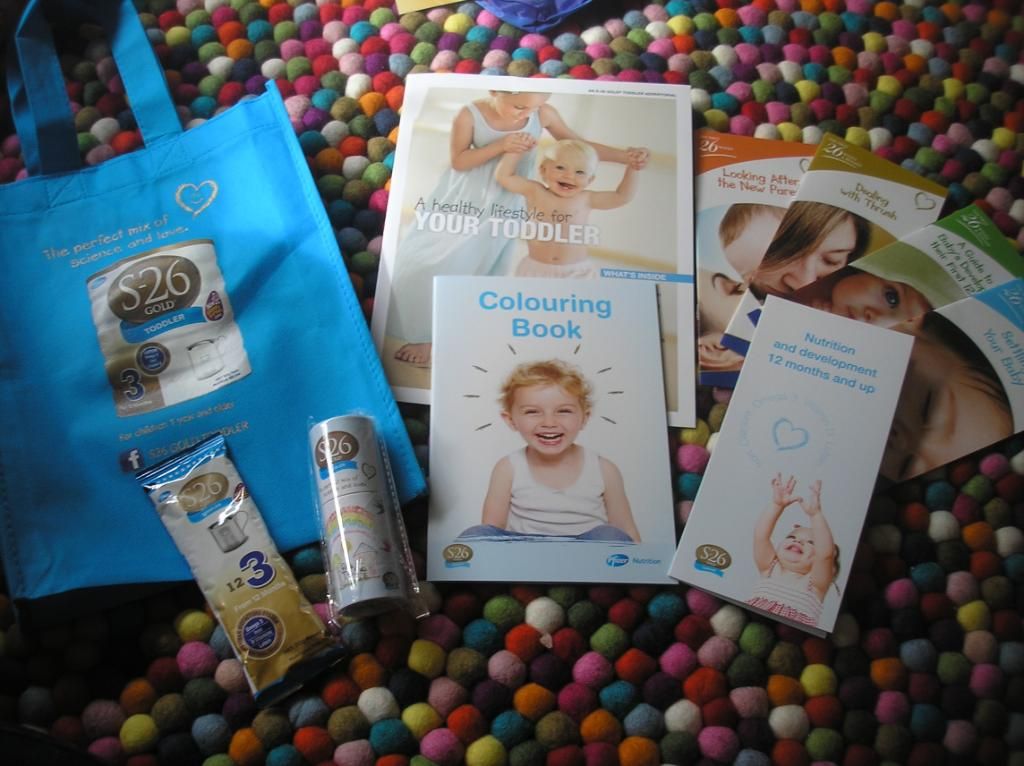
Here are the 'generous' gifts they showered me with.
From Nestle:
- A branded reusable bag (branded with the 'baby club')
- A branded colouring book
- A branded cooler bag
- A whole stash of 'advice' leaflets.
Nestle
From Wyeth
- a branded reuseable bag
- a branded colouring book
- a pack of branded crayons in a branded colouring tube
- a sample of toddler formula
- more 'advice' pamphlets
Wyeth
These 'free gifts' are full of practical, useful items and are covered in logos. Have a look at the colouring books. The Wyeth one has the S26 logo on the bottom of every page, and the pictures on the Nestle one are actually pictures of the blue bear logo doing things!

See how the logo is on each and every crayon, too?
Everything item in these bags - and the bags themselves - are designed to be used. These were given out at a baby show. Where are people who attend baby shows likely to go afterwards? Somewhere where there are other parents of small children. What's a great thing to keep small children busy? Colouring books. With crayons in a super useful travel tube. All with 'S26 Gold Toddler' written on them. The more you see something, the more normal it becomes.

The cooler bag from Nestle is one of my 'favourites'. Just like branded scale mats and branded breast pads, a cool bag is perhaps one of the worst items which could be branded by a formula company. When is it likely that a parent would be packing a cool bag which is the perfect size for a day's worth of bottles? Possibly when the child is heading off to day care, which is likely to coincide with Mum's return to work. Continuing breastfeeding while working is almost always possible at least in part, but depending on your circumstances it can be anything from super easy to really. damn. hard. So when things get tough and you're packing bottle for day care and you're stressed about if you'll have time to pump at lunch time and if you've recharged the pump batteries, there's the friendly little blue bear there on the cool bag as a reminder.

Yes, these packs did contain lots of advice saying how breast is best and that the WHO recommends exclusive breastfeeding for six months and that you should talk to your health professional before using infant formula. Well, some of it did. The stuff that has to, that is.

Firstly, if you look closely, you will see that the logos are either for a baby club, or for the toddler formula. As I said above, advertising of infant formula is not allowed, but toddler formula is. The toddler formula logos look very similar to the infant (0 - 6 month) and follow on (6 - 12 month) formula logos, which is very intentional. By advertising the almost-identical logos of toddler formula, then there is recognition of the advertising-prohibited logos at the point of sale. Toddler formula has no extra nutrition that a child couldn't get from a cup of full cream cows' milk and a multivitamin (which would be much cheaper) but it's the advertising loophole that it exists to jump through.

The other logo that you see a lot is the baby club. This is linked to the 'advice' pamphlets too. These are dangerous for two reasons. Firstly, they are dangerous because it promotes the idea that these companies have babies' health as a priority. (If this was the case, then why do they not follow the guidelines to protect their health which they know aren't enforced under law?) Secondly, 'information services' such as baby clubs, pamphlets and help lines are clearly and specifically defined as marketing.
"Marketing" means product promotion, distribution, selling, advertising, product public relations, and information services.
Article 3 International Code of Marketing of Breast-milk Substitutes
Now, I did have to give the formula companies something in order to get my 'free' gifts. My all important email address, and the ages of my children/ estimated due dates. I needed to answer a whole series of questions about my baby - none of the nappy companies wanted to know any of that before they gave me their samples. They wanted all that information so that they can fill my inbox with age appropriate 'advice' - which can be timed to when things are probably going bad.

You'll notice that I said above that they only had the 'breast is best' spiel when they had to? Despite the fact that breastfeeding is recommened until two years and beyond, there is no mention of the 'breast is best' stuff on the sample of S26 Gold Toddler in my goodie bag. (And yes, giving out samples is against the WHO Code, too.) If Wyeth really thought that 'breastmilk is best for your baby' then why aren't they saying that on a sample for babies over 12 months - because the law doesn't make them.

So why did I get the bags? Well, to be honest, I wanted to share these unethical practises with my blog readers to expose them. I knew very well what would happen if I went into the baby expo. What will I do with the stuff? As much as I hate throwing useable things away since it's wasteful, I used the perfect- condition bags as bin liners; the garbage truck will pick them up in the morning. The Nestle colouring book and all the 'advice' marketing got tossed too. The crayons I've kept since I do love the tube - I'll see if I can cover it over somehow? The cool bag is actually the perfect size for Chubs' lunchbox (not the one I send her to daycare with, but the sections one that she eats from throughout the day if we're out and about.) It's really good quality too, so I'm going to see if I can cover the logo up somehow. The S26 sample? I'll mix it up and give it to Chubs one day instead of the soy milk or cows' milk she would have had otherwise, maybe on her breakfast cereal - but I can assure you that I won't be buying a tin any time soon.

Do I expect to change the world by whinging about a few sample bags? Well, like anything, probaby not. But if it makes a few more people aware of the sneakiness that goes on and to look at these giveaways a little more cynically and with a little more caution, well you know wht they say. They ones who are crazy enough to think that they can change the world are the ones who sometimes do.


Linked
PS - no reply back yet from the pharmacy CEO...

Monday, 25 June 2012

Happy birthday to my breastfeeding baby

I posted about how Chubs turned one not long ago and we had a wonderful rainbow party for her. She is definitely a toddler now, not an infant. She is walking (running actually), knows a few words (Mum, Dada, ta, NanNan, stop and just this week, socks and dinosaur. I'm not kidding) and a few signs, had the most adorable pigtails and loves to dance to any music she hears. She recognises her favourite characters, will wave to puppies and people, can get off the couch or an adult bed safely and can play peekaboo. Heck, she even squirts antibacterial gel on her hands and rubs them together when we leave the petri dish that is daycare (that's my little germaphobe!). She is certainly not an infant. She's a walking, dancing, breastfeeding little girl.

It is not common to see a breastfeeding toddler. Indeed, I was first asked if she was almost weaned when Chubs was four or five months old - we hadn't even started solids yet. In Australia a little over 20% of babies are breastfed at 12 months (1) and many fully wean soon after. It is even less common to see a toddler breastfed in public. This is partly because some women find it easier to avoid the critism and just feed at home, but also practical - a toddler is not a newborn, and a toddler can be expected to wait for a feed if it's not convenient.

A toddler can also be expected to use her manners. We taught Chubs the sign language for 'milk' which she uses when she wants a feed. I much prefer her to look at me and make the sign for 'milk' (which is oh-so-cute) than to whinge and scratch at my shirt front. She is a big girl, she can use her manners. I love that when she's done she says 'ta' and pulls my shirt down to cover me up again. Of course, there's the phrase 'if they can ask for it, then they're too old for it'. Well, using that logic, Chubs has been to old since the day she was born. She 'asked' for a feed then by rooting around with her mouth, by sucking her fists and by crying. She can ask for a drink of water now by pointing at her sippy cup. She can ask for a story by picking up a book and bringing it to me - she will even swap books from my hands if she wants a different one to the one that I was trying to read to her. So using that logic, she's too old for a drink of water and a story, too. Even when she is old enough to say 'Mummy, can I have a breastfeed please?' it's not her need and desire for breastfeeding which has changed, but her cognative and language development.

So why am I still feeding her? In summary, because it is good for her, it's good for me and it's biologically normal. Nutritionally, breastmilk can provide a toddler with 31% of energy, 38% of protein, 45% of vitamin A, and 95% of vitamin C daily requirements (2). She's been a bit coldy recently and we've been trying to get her to eat some mandarins for the vitamin C but she's not been a fan. When I saw that statistic I relaxed a lot. It's a great food which is perfectly designed for her.

The immune benefits are huge - even if you ignore the nutritional and comfort benefits. If you could go to the shop and buy some sort of  'toddler immune supplement', imagine the claims they would make.
- Immune boosting properties
- Perfectly designed by a human antibody making machine
- Tailored exactly to the specific environment that you live it. Get antibodies to many of the diseases you are likely to come in contact with, both over your life time and in the short term.

Can you imagine how much of that would get sold? I can give that very substance, full of my antibodies, straight to my daughter for free, and yet I still feel the need to justify it?

The benefits of breastfeeding, of course, are more than just the properties of the milk itself. The comfort and closeness of breastfeeding is beneficial for both mother and baby, indeed the whole family (see Dear Husband's comments below.) A breastfeed can soothe a skinned knee or a shove from another kid at the playground. What's the harm in that? Many people comment on breastfeeding as shown in 'The Slap', where it was often used to avoid discipline. The problem there is not with the breastfeeding itself but the way it was used, in the same way that anything can be used as a distraction to avoid discipline. A feed to reconnect after a day apart at daycare/ work, a feed to sleep or to resettle at night or a feed after a tumble off the climbing frame at the park - a wonderful way to soothe and comfort my precious girl. There is no evidence to suggest that breastfeeding causes clinginess or emotionally needy children, indeed the opposite is often the case. She will grow out of needing to suckle for comfort, just as babies grow out of needing to suck on a dummy/ finger, needing a teddy or a blankie for comfort or needing to be swaddled at night to sleep. She will grow out of this when she is ready, or I will encourage her to wean if I'm not happy to keep feeding, but while we are both happy and both needing this connection, it will stay. Indeed, some women (such as those who have rare conditions leading to chronic under-supply like Insufficient Glandular Tissue or those who have intitated breastfeeding for an adopted baby/ child) breastfeed their child for small amounts of milk for its non nutritive benefits, and then feed the baby with a bottle for the bulk of their food requirements.

Dear Husband says that his attitude has changed. 'Now that I realise the health benefits of breastfeeding a toddler, I don't look at Chubs and think 'she's too old'. I think that we're doing the best for her health and her future by continuing and I'd rather do that for her than for her to have artificial / processed foods.' He also added about breastfeeding an older baby in general 'Some women can't and that's ok, but I think it also fosters a much more nuturing feeling in the home. It's really nice that Chubs will be playing on the floor with her toys and then she'll pop up and do the milk sign, it's a nice loving atmosphere to have'.

The World Health Organisation recommends breastfeeding for two years and beyond; and not just in third world countries, either. Dr Katherine Dettwyler (an anthropologist) has extensively studied weaning ages in other animals, particuarly non-human primates. She compared the weaning age of other mammals (particuarly large body weight non human primates) against factors such as length of gestation, weight gains, teeth development and age of sexual maturity. Using these studies she has determined he natural age of weaning for humans - that is, the age at which weaning would proably occur without cultural influences - to be between two and a half and seven years of age. Many refer to breastfeeding past 12 months as 'extended breastfeeding' but I'm not a big fan of that phrase. If it's the normal timeframe that someone should feed for, then what's extended about it? That's like saying that because we can keep babies born at 25 weeks gestation alive through artificial measures, then having a pregnancy last nine months is 'extended pregnancy'. I think the phrase 'full term breastfeeding' is more appropriate.

Now it's easy to say what things would be like without cultural and societal influences, but of course we do live within a society with expections, norms and influences. For example, gorillas can wean at whatever age they want; that doesn't change the fact that Chubs goes to daycare while I'm at work, which is obviously a hurdle in our breastfeeding relationship. 'The real world' is were we live each day, so to pretend that it doesn't exist would be foolish and unhelpful. However; here's perhaps the best thing about breastfeeding a toddler - I've already done most of the hard work. Chubs is a healthy little girl who enjoys a diet of many foods and is not reliant on breastmilk for all her nutrition, indeed some days she has very little breastmilk at all. There's no rushing home for a feed any more and it's much easier to plan feeds around a glass of wine, rather than the other way around with a pumped bottle, 'just in case'. I've not left any pumped milk for her (except at her nine/ ten hour long daycare day) for months. At 12 months my milk supply is 'practically bulletproof' - I no longer need to worry about a missed feed (or two or three). Cracked nipples, leaking and engorgment are a distant memory of last winter. Yes, breastfeeding an older baby does bring some new challenges. Since six months we've faced challenges of biting (with teeth!), sore breasts from acrobatic feeding and supply drops during my periods, but the bulk of the hard work is done. Most of the benefits for a fraction of the work - woo hoo!

I will be dropping my pumping session at work from this week, which will make a HUGE difference to my stress levels during the work day. No longer will I need to pack up the breast pump the night before, charge the batteries, pack the ice packs, go through the nightmare that was trying to fit pumping sessions into an impossibly tight teaching day, take home my expressed breastmilk in the cooler, scald the milk to inactivate the lipase and put it into labelled bottles for the freezer, wash the pump parts, recharge the batteries and then pack it all up again the next day. Once I've finished up my small freezer stash, Chubs will have soy milk or cow's milk at daycare.

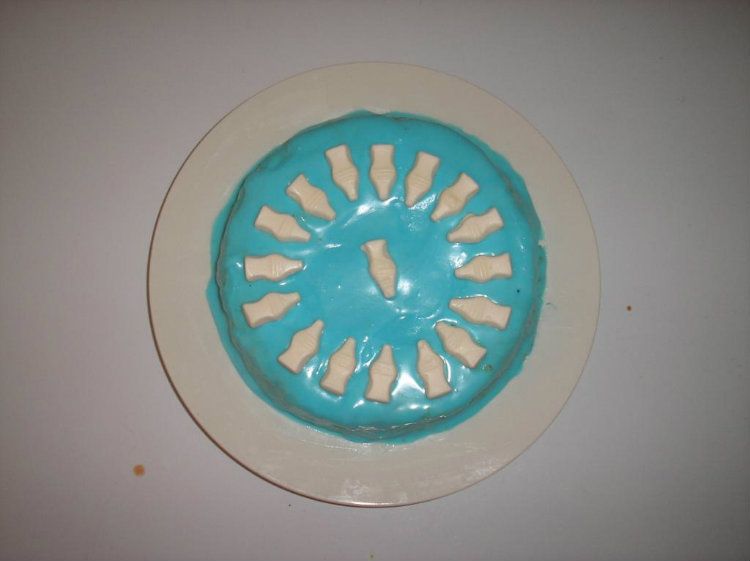
I have to thank a close friend and colleague for her support during my pumping journey. We're a bit tight for space and there is no free room available at my work that I can pump in; not even a store room or something like that. (I don't have my own office but share a staff room with ten other teachers.) I've been using her office to pump in for the last six months and I really am indebted to her. If it wasn't for her letting me use her office to pump, then I'm not sure what I would have done. Had it not been possible to pump at work, then worst case scenario would have been early weaning. Thankfully I was able to avoid that. It was inconvenient for her since she needs to use her office to you know - do work in, so I appreciate that she made the effort to reorganise her day so that it would be available for me as much as she could. To thank her for her support, I made this cake to express my thanks. (See what I did there :) )
I put little milk bottles on it since they don't make little breast pump lollies.
I hope you're all impressed that I made it from scratch, too!
Breastfeeding a toddler is not only good for Chubs, but it's good for me too. Breastfeeding past 12 months lowers my risk of osteoporosis, breast cancer, ovarian cancer and anemia (3). In the same way that breastfeeding helped my body to recover from my (hellish) pregnancy, it is still helping my body now. I love that we have our special time together - well, most of the time I love it, sometimes it's frustrating out of my mind, but aren't most things with a toddler? It's a great tool for getting her to sleep and back to sleep - I'm sure I get more sleep because of breastfeeding than I would otherwise. If for no other reason than that it's a good idea! Mummy loves her sleep... :)

So, where to from here? Well, simply - on. Breastfeeding is beneficial and enjoyable for everyone in our family, so we will continue. Perhaps Chubs will wean soon on her own, perhaps I will encourage weaning. Perhaps something will happen which will force weaning; I don't know. There are two people in this breastfeeding relationship and we will continue while everyone is happy.

Do I think that everyone should breastfeed their toddler? Do I think that everyone should breastfeed full stop? As I've mentioned before, I'm a keen advocate for breastfeeding, I think it's an important public health issue and I obviously talk about it a lot. I feel that it is a responsible thing to speak out about unethical advertising of formula companies and to normalise breastfeeding. However, how a particular family choses to feed their child is totally their business, and none of mine. I fully respect others' choices as to how they feed their children and at what age they wean. There are as many different feeding/ weaning stories in the world as there are children and that diversity is to be celebrated. Please don't read this post as me telling others what to do. It's about me sharing our family's journey so far and the reasoning behind it. If you can take something from it which you think is worthwhile for your family, then I feel honoured. This is not an anti-formula post in the slightest, but a celebration of my precious breastfeeding relationship with my beautiful walking, dancing, breastfeeding little girl.

Linked

1 - Donath and Amir, 2000
2 - WHO/CDR/93.4
3 - Mortensen, K. Lactation Resource Centre

Thursday, 23 February 2012

The prize for...

... the thing I'm missing most this week is taking Cold and Flu tablets. I'm fighting a cold which Chubs brought home from the petri dish which is daycare. Since I'm breastfeeding, I can't take decongestants like pseudoephedrine. The concern isn't that they will go though my milk (because that's not generally an issue with decongestants,) but that they will reduce my milk supply. So sadly, I battle on. I think being able to take psuedoephedrine is what I miss most with pregnancy/ breastfeeding - even more than drinking alcohol without planning it, wearing dresses or anything else.

Incidentally, there are very few medications which are totally incompatible with breastfeeding. Many health professionals are quick to say that medications can't be taken while breastfeeding and the mother either needs to do without the meds she needs, or wean. However, on closer inspection, for most medications it is actually possible to meet the mother's needs without weaning. Depending on the medication, dose, age of baby and frequency of feeding then it may be very safe to continue to feed the baby while the mother takes the medication. For example, some medications can be taken soon after a feed and will have mostly passed through the mother's body before the next feed. Sometimes the amount passing into the milk and then being absorbed by the child is negligible. The effects of the baby receiving some medication also needs to be weighed against the risks of not breastfeeding. If the medication needs to be take for a short time only, then 'pump and dump' or even relactation can be considered.

Obviously, the details of every situation are different and you should seek actual professional advice, not the musings of someone who went to a few undergraduate pharmacy lectures and likes pontificating on her blog. I do urge you to see the advice of a pharmacist who specialises in drugs and lactation. It is an underrepresented field which is very important. Many doctors and pharmacists will give advice about breastfeeding without actually being aware of the specifics of the particular situation. If you have this dilemma, then I urge you to seek the advice that you, your child and your breastfeeding relationship deserve.

For me and my blocked nose, it's a no brainer. Putting up with a few snotty days vs early weaning - of course I can suck it up (or sniff it up, actually. Sorry for that visual.) However, if it was a chronic and/ or serious condition which I needed to treat, I would certainly seek more advice. Although, I'm almost looking forward to my first post-weaning cold when I can take some Cold and Flu tabs without a second thought.  I know, I'm strange...

Thursday, 9 February 2012

The prize for...

... this week's good idea is sitting baby up before lifting her when changing her nappy. Ever since Chubs could sit up with support, I've done this. When nappy change is finished, I pull her up to sitting, and then lift her up. I find this is much less strain on my back than lifting her up while she's lying down.

I hope this will keep working as she gets bigger. Any other ideas to make lifting bubs easier?

Monday, 6 February 2012

Dear Facebook: Breastfeeding is not obscene


Tomorrow will be a big day at the Facebook office in Sydney. Breastfeeding mothers are planning on having a 'nurse in' to protest against the way in which breastfeeding photos are continually treated as obscene by Facebook, and photos are removed and accounts have been locked in response to this. Whilst Facebook officially says that they have no issue with breastfeeding photos, time and time again this has been shown to not be what actually occurs. (More on their policy below.) For more information see here. This event is also occuring at other Facebook offices around the globe.

Breastfeeding is a normal part of life, and should therefore be shared with one's social network. Indeed, a woman's right to breastfeed (in public or anywhere) is protected under Australian law. It is therefore perfectly reasonable and healthy to post photos of breastfeeding on one's Facebook page.

There are some who would disagree with my statements with the following arguments which I will address in turn.

"Going to the toilet is natural too, that doesn't mean you should post photos of that"
I would like to preface this by saying that anyone who doesn't know the difference between having a meal and defecating is not welcome in my kitchen. This implies that a baby feeding is dirty, unsanitary and should be behind closed doors. Firstly, this is not the case - a woman has the right to feed her child wherever she and her child are allowed to be. Secondly, following this logic, then all eating by people of all ages, breathing and moving are not fit for public display, because they are natural too. This is absurd.

Exposed breast while feeding a child = porn
The idea that a breast, and therefore breastfeeding, is sexual is an idea which is firmly intrenched in society. Do you recall the media fuss when photos of Miranda Kerr breastfeeding were released? Some was negative, a lot was positive, but consider the fuss which is made of normal bikini modelling photos of Kerr. That's right, not a blip.

Body parts can have multiple roles. Yes, breasts have a sexual role. A woman's hands, lips and tongue also have sexual roles. If breasts need to be covered in public because they are sexual, then all women (and men for that matter) should be wearing gloves whenever they leave the house. Many people in Western countries find the idea that a woman is required to cover her face very oppressive and offensive. Following the breast = porn logic, then everyone should be wearing veils as well as gloves.

"I'm all for public breastfeeding, as long as it's discreet"
This is one that really gets my goat. Firstly, let's define 'discreet'. If by 'discreet', you mean 'put a blankie over your shoulder, your baby and your breast' then I would like to suggest that you may be unaware of how to breastfeed. The most probable time for a 'nip slip' is when the child is attaching, which is also the least practical time to cover up. Most mothers, especially in the newborn months, need to see their baby's mouth and their breast as well as using about ten hands to get the baby to attach properly. This is practically impossible to do under a blanket or nursing cover. In addition, some (many?) children are quite uncomfortable feeding under a blanket and will simply rip the blanket off, or scream (and not feed) until it is removed.

If by 'discreet' you mean 'invisible' then I would counter that again breastfeeding should not be invisible. Again, it is the normal way to feed babies and should be seen as much as any other normal activity like greeting a friend, colouring in, playing in the sandpit or going for a swim at the beach. In addition, feeding with a blanket or a nursing cover usually only serves to draw attention to the fact that one is breastfeeding. I have breastfed during professional development sessions, staff meetings, meals with friends and family and many other occasions when people around me were totally unaware of Chubs' feeding, and on none of those occasions did I use a nursing cover.

Secondly, breastfeeding should not be discrete any more than any other activity. Many babies are more comfortable feeding in a quiet room, or under a blanket to protect from distractions. Some mothers choose the privacy of a nursing cover or a feeding room. (Indeed, there have been times when I have moved to a different room to feed when I felt that was the best thing to do in the circumstances. I also tried to feed Chubs under a blanket when the 'distracted stage' set in at about five months.) Some people prefer to take phone calls in private, some people don't like to talk about their financial matters in front of others. In each of these examples and countless others, the choice for privacy is just that - a choice - not a dictated rule.

"Ugh, I don't want to see that"
Some people will argue that the appropriateness of breastfeeding in public is merely a difference of opinion. This is not the view that federal law takes. A woman's right to breastfeed her child anywhere that she or her child are allowed to be is protected under the Sexual Discrimination Act of 1984. Recent ammendments also specifically including expressing breastmilk under the Act. (Expressing was never excluded, but is now specifically addressed.) To ask a woman to stop breastfeeding, to ask her to move on or to refuse her service because she is breastfeeding is unlawful and sexual discrimination. I believe anyone who thinks that it is ok to do any of these things should say exactly what that believe - that sexual discrimination and illegal behaviour is acceptable to them.

Further words on Facebook's breastfeeding policy.

Firstly, as said above, the big issue is that Facebook employees appear to be acting outside this policy.

Secondly, in response to
Photos that show a fully exposed breast where the child is not actively engaged in nursing do violate Facebook's Statement of Rights and Responsibilities
I would certainly be interested to see how Facebook, and the Human Rights and Equal Opportunities Commission, would define 'not actively engaged in nursing'. I would wager that the person who wrote this policy has little understanding of how nursing works, especially with older babies and children.

Thirdly, in response to
It is important to note that photos which we act upon are almost exclusively brought to our attention by other users who complain about them being shared on Facebook.
Other people can make complaints which are racist, sexist, inflammatory or just plain wrong - that does not excuse Facebook from acting decently. Indeed, is that not why the reporting mechanism exists, so that Facebook can assess the validity of a complaint before acting (or not acting) on it?

Breastfeeding is a normal part of life. Social networking is about sharing our lives with others, and that includes breastfeeding. Shape up Facebook and practice what you preach. Breastfeeding is not obscene. For more information and to add your voice visit the Facebook group for the Sydney eventopen letters to Facebook and some of the images considered to be 'obscene'. Please also add your views in the comments below.

Sunday, 5 February 2012

Being safe when bubba is sick

When bubba is sick, it's so awful for everyone. Your precious baby is sick and in pain, and we as parents try to do everything we can to fix it. In my more lucid moments when I don't have a screaming, sick baby I worry that crying child + stressed and tried parents + quick actions to try to fix the problem = potential for things to go wrong. We have two rules which I hope will act as a safeguard to prevent any medication overdosing.

Firstly, only one of us (either my husband or me) gives Chubs her medicine. Usually it's me, since I'm getting up and doing the night feeds anyway, but if I'm exhausted then I will nominate him as the medicator-in-charge for that night. We are hoping that this will prevent one of us giving a dose at 1am in a sleepy haze, and then the other giving a dose soon after.

Secondly, we check the dosage on the box every. single. time. Ibuprofen and paracetmol have different required volumes, and the dosage of most medicines increases as your child grows. Some medications are available in different concentrations, so they may require different volumes for the same amount of active ingredient. This means that what the dose was last time - the dose you have remembered in your head - may not be the correct dose. So we check what the correct dose for weight is, and check that the same number is what is in the syringe/ cup each and everytime.

Over the top? Perhaps. Better than accidently overdosing and making bubba very sick? Definately.

How to cook a meal (written by someone who can't cook)

I am not a domestic goddess. Far from it. Unfortunately, my family and I still need to eat. My husband often takes care of dinner, but I do need to pull a rabbit out of the hat (or dinner out of the freezer) every now and again.

I'm a big fan of freezer cooking, mostly because I'm lazy. The recipe below is for (Spaghetti) Bolognese and it freezes well. I just cook the bol and freeze that, then cook the pasta fresh on the night. My husband has rice instead of pasta; sometimes I cook that and freeze it with the meat, other times we just cook it fresh on the night.

Freezer cooking is great, since I can cook at a more convenient time (that is, after Chubs is in bed) and if I cook in bulk then we get a few meals out of it. This means less preparation, washing up and fuss in general.

Bolognese
The portions here are for eight serves, so four dinners for our family of two big people.

Ingredients
1kg beef mince (I buy the cheapest stuff and drain it, but you may prefer the leaner stuff)
2 cups frozen veggies (you could use fresh if you wanted, but I'm too lazy)
1 onion, diced (I skip this, but supposedly everyone else in the world likes onion)
1 tin tomatoes (crushed, chopped, whole or whatever was on special that week)
1 jar pasta sauce (I said this was a recipe for someone who can't cook)
2 glasses of wine (substitute for your favourite tipple as required)

Stick the onion in the pan until it goes clear-ish (allegedly this happens - like I said, I skip this bit.)
Brown the mince and drain the fat if you're a cheapskate like me who buys the low grade fatty stuff. I find it easier to brown 500g of mince at a time, and then stick all the browned mince in together for the next steps.
Tip in the tinned tomatoes and the jar of pasta sauce, stir and let it simmer for a bit.
To keep busy while you're supervising the simmering, start drinking the first glass of wine.
When it seems to 'come together' after about five minutes, add in the veggies.
Let it simmer some more for about ten more minutes until it reduces a bit and you finish your wine. Dish the bolognese up into whatever containers you are freezing it in.
Label the containers, bung in the freezer and pour yourself a congratulatory glass of wine.

If you really want domestic goddess points, do the washing up as well instead of leaving it for later. You get another glass of wine if you're good enough to do the washing up, too.


This certainly isn't going to get me on any TV cooking shows, but it's fairly cheap, reasonably healthy, simple to cook and dead easy to upscale to make in bulk for the freezer.

Also, can you tell I'm breastfeeding and miss cooking with wine?


Check out this link for more frugal meals

Thursday, 2 February 2012

The prize for...

Hello Baby
...this week's beautiful book goes to Hello Baby by Jenni Overend. This charming story is illustrated by the celebrated Julie Vivas whose soft, warm watercolours also appear in books such as Possum Magic and Wilfred Gordon McDonald Partridge.


The picture book tells the story of Jack and his family. Jack and the others have been awaiting the day of the homebirth of his little brother or sister. The day finally arrives, and Jack and his sisters, father, aunt and the midwife help his mother through her labour, birth and the first few hours of the new baby's life.

This book isn't scary or ick, but is a beautiful, loving birth story. You certainly don't need to be a homebirth advocate to enjoy the miracle in this book. I first came across this book as a teenager when I was babysitting for a family. I was then and am now probably one of the least likely people to plan a homebirth, but even as a fourteen year old I could appreciate the warmth of this picture book.

As well as just being a lovely story in its own right, then book could also be used to initiate conversations about babies, birth, pregnancy and family changes. This book is full of warmth, closeness, cuddles, excitement and love - just like the birth it talks about.

Tuesday, 10 January 2012

Ideas for cool babies on hot days

It's a stinking hot day here in the middle of a very hot summer, so we're all feeling a little bit wilted here. Here's some ways to keep baby cool in the summer.


Seek the cool

If it's wet, shady or has air conditioning, then go there! Visits to air conditioned libraries, shops, a friend's house with air con or anywhere else you can find the cool, especially in the hottest part of the day, can make a big difference. A swim at the beach, a pool or in the bath tub can also be great, especially in the late afternoon while waiting for the cool change to come through.

 Avoid the hot

Super hot days generally aren't the days for a bush walking adventure, playing sport, gardening or sunbaking (eep!). If you don't have air conditioning in your car, then it's crucial that you try to avoid all but the shortest trips if you have a little one. Cars get so hot in the sun, even with the windows down and the parents in the car. If you can't delay a drive across town or on the highway, then see if you can leave bubba with someone else, borrow a car with air conditioning, or leave very early in the morning or in the evening to avoid the sweltering hours. If you find youself with no option but to do a long drive in the middle of a hot day (as we did once) then you'll need to be almost in crisis mode. Do whatever you can to keep bub from being overheated - perhaps someone can sit in the back seat and fan baby, use a window shade (or tea towel) to keep the sun off bubba, wipe baby with a cool washer and keep the baby well hydrated.

Keep hydrated

It's so easy to become dehydrated when the weather's hot. Exclusively breastfed babies don't need to drink water as long as they are frequently offered the breast. More frequent nursing will cause the mother's supply to increase to respond to her baby's increased thirst. Short, frequent feeds also means that bubba will get more thirst quenching, watery foremilk (as opposed to the richer hindmilk) which is perfect for a hot day. Babies should have at least 5 - 6 heavy wet disposable nappies/ diaper, or 6 - 8 cloth nappies in a 24 hour period and urine should be very pale yellow or clear and not have a stong odour. If your bubba dehydrated, then try offering more feeds. Older children and adults should be passing urine every four hours and again it should be pale yellow and not have a strong odour - otherwise increase the fluids and cool down. Of course, if you or your child is very dehydrated and doesn't improve, then seek medical advice.

When it's hot the idea of being snuggled in close to someone to feed seems like a terrible idea, so often babies (and mothers) don't want to nurse when it's hot. Try feeding lying down, so that only you baby's mouth and your breast need to be touching. A tea towel or other cloth between you might also help avoid sticky, sweaty skin. As mention above, short and frequent feeds are generally best in hot weather and may be more bearable.

If you baby has formula and/ or is taking solids, then you may also offer some cooled, boiled water in a bottle or sippy cup. Don't ever water down formula or expressed breast milk - stick to the manufacturer's instructions, but you can offer water separately. Watery solids like runny stewed apple, watermelon, grapes and slushy purees can also help keep your baby hydrated. Water play with a few cups and face washers can also provide opportunities for bubs to stuck on some water.

Don't forget to keep yourself hydrated too. Thirst is a late dehydration sign, so keep drinking before you get thirsty. Lots of water or other cool drinks, watery fruit and seeking the shade are important for the big people as well as the little ones.

Try not to wear the cranky pants

Hot, sticky days usually mean whining, moaning, fidgeting and general crankiness. Your kiddies will probably feel this way too. Try to be sensitive to the decreased tolerance level in your family. Avoid stressful discussions if you can, get some space if you need to and don't try to do anything but the essentials.

Fun (and useful) hot day activities

Water play with a tub, some plastic cups and a few toys might keep bubs and you occupied and cool for a while.
Get a bucket of water and fill up lots of cups with water in the sandpit. Tipping them out will cool bub down and make the sand wet for better sand castles.
Grab a pile of books or pop on a DVD, get some cool drinks and set yourselves up for a lazy day in front of the fan or air conditioner.
A baby in the high chair with some ice cubes on the tray (or a wet washer in the freezer) can be fun to play with for a while.
A swim in a pool or a beach is great - just avoid the sun in the hottest time of the day.
If you've got air con in your car, a hot day is a great day to visit someone on the other side of town (or maybe the next town over...)
Turn the fan up to 11 and sit in front of it. See how it makes your hair go, send small pieces of paper flying across the room, and see what funny noises you can make by talking into the fan. (The kiddies might want to play this game too :) )
Anything air conditioned - movies, the library, ten pin bowling, shopping or a play centre.

For more advice about babies and hot weather look here , and stay cool!
Related Posts Plugin for WordPress, Blogger...