I came across this link recently,
and I believe this mother makes an excellent point.
Formula is not white poison. It's not heroin. It's not the enemy.
Can I say that again loud and clear. FORMULA IS NOT THE ENEMY.
Formula is a breastmilk
substitute. A substitute, a replacement, an alternative. Even the frigging WHO Code refers to ‘breast milk substitutes’. There’s a reason it’s not called the “International Code of Marketing of Baby Poisons”.
If I can’t teach a class, they get a relief teach in as a substitute. Not a
criminal, but a substitute teacher. If I don’t have a bib when we’re out, I can
substitute with a napkin. Not with a sheet of asbestos, but with an acceptable
alternative. If the route to work is closed due to traffic, I can go the long
way round. Not give up on work entirely, but find a different route.
Yes, formula is not as good as breastmilk. Yes, it carries risks (but so do
all methods of feeding). Yes, donor milk is often (but not always) a better
alternative. But formula is an acceptable substitute.
Existing readers of my blog will know that I have some pretty strong views about the unethical advertising of formula, but that does not mean that the
product is bad. I think that a lot of the marketing techniques of
pharmaceutical companies are pretty abysmal (and in many ways similar to
formula companies) but that doesn’t mean that I think medications are evil.
Actually, medications are very similar to formula – in some cases they are essential
and lifesaving, and in many cases they are ‘just’ helpful and convenient. Medications,
like formula, are susceptible to being used inappropriately and their use needs
to be carefully managed to minimise the risks – but they aren’t the cause of
everything bad in the world. They are a GOOD THINGS - sometimes used inappropriately
and dangerously (often fuel on by dodgy marketing) – but still fundamentally a
GOOD THING.
Before I start this post proper, I would like to start this post with what I usually say when I talk about formula advertising. This is in no way, at all, in any way, a critism of how parents feed their children.
Yes, I'm a big breastfeeding fan, however, how someone else chooses to feed his/ her child is not my concern. Yes, I think that breastfeeding (or not) has public health implications, but so do many other things. Someone may write a blog post explaining why exercising regularly is great for the health of your family, and what the risks of not exercising are. Someone else may tell me about their experiences with in home/ family day care, and about how it meets the needs of small children better than other forms of care. Someone else may write a blog post about how car manufacturers encourage dangerous driving by making speeding look attractive, which may encourage reckless driving behaviour. None of these things mean that I am a bad person because I don't go to the gym, I send my daughter to a daycare centre and I have a red car, nor do I think that that is what these hypothetical posts intended.
This post is not several things too. It is not anti formula. It is not passing judgment on how someone feeds their child, it is not meant to be advice, it is not 'telling off' formula feeders. Kick me out of the "yay boobies" club if needed, but I don't think that using formula is something which demands a defence or explanation to random strangers or society at large.
This post is several things - it is a brief commentary on unethical advertising, it is an attempt to raise awareness about these tactics and it is an act of advocacy. With this post, perhaps one more seed of change will be sown. It may take many years, probably decades, but perhaps this post can be one tiny part - though a part none the less - of this change.
Now, for the post proper...
Recently a landmark decision was made in the Australian High Court which is of international significance. (Before I go on, I am in no way a legal expert beyond a fondness for big words, so please forgive my lack of understanding of detail and feel free to correct me if required.) The Australian Government introduced legislation which would force cigarette packets to have plain packaging. Plain packets, no logos or pictures (except for the graphic warning label) or colours or fonts - just a plain packet with the brand name printed and the information about the type and number of cigarettes and so on. It is my understanding (and again, my legalese is very minimal) that the tobacco companies fought against this legislation on the basis that it infringed on their intellectual property rights and that such legislation was not permitted under the constitution.
The good part? The tobacco companies lost. The best part? They had to pay the Government's legal costs, too.
It got me thinking about unethical advertising, and in particular about how similar the sneaky techniques of tobacco companies are to formula companies.
Do you remember cigarette ads like these?
Nope, me either. That is, I remember seeing them in books and blog posts, but as items relegated to the dark ages of pop culture history. I think how amusing it is that cigarettes - perhaps the worst health invention ever - were being advertised as healthy. The worst aspect of the health issue is the respiratory system, and that's the very thing that the advertisments were saying how great cigarettes are - smooth on the throat. Throw in some puffed up professional expert endorsements (like physicians and scientists) and a good drag of pseudo-science and you have an addictive and attractive advertising campaign.
At least, I think it's amusing, until I remember that this actually happened to real, actual people. It's not so amusing, then. It still seems far fetched, though. As a child of the 80s I can't imagine that people actually believed the ads that said that cigarettes were healthy.
Of course, I realise that times change. The high court decision about the tobacco advertising got me thinking - in fifty years time, will the idea that formula was marketed as a health product seem unbelievable? I hope so.
When I was a child the idea that cigarettes were health was long gone of course, although cigarette advertising wasn't. I can't remember ever seeing any cigarette ads on TV, but I remember seeing lots of logos on billboards and lots of sports sponsors. I recall the Windfield Cup and logos adorning atheltes and sporting fields alike. I saw a story on TV about a couple (I think - I was small and it was a long time ago) who ran an informal coast guard service or something; paid for by advertising 'Winfield' in glorious red and white on the side of the boat. The couple were concerned that the (then) soon to be introduced laws banning cigarette advertising would mean that they would lose their funding for this community service. There was an advertising campaign a few years ago against plain packaging - poor, hard working corner store owners couldn't afford to have reduced (cigarette) sales so we should get plain packaging.
None the less, cigarette ads were banned, and now we have this landmark plain packaging. I think it's a huge step in the right direction. If one of the claims against plain packaging "it won't work so why do it" was true, then why were the tobacco companies so worried that they went to the extreme cost of mounting a high court claim? If they weren't really, really worried, then why bother? Now, back to formula. Some would suggested that likening formula advertising to tobacco advertising is ove the top, but I don't think so. The issues of advertising is even more of an issue with formula - formula is a legimate product which is very much needed. Yes, only by a small number of people in a small number of circumstances, but needed none the less. One could reasonably argue that cigarettes could or should be banned completely; not so for formula. As even the rigid breastfeeding supports will claim; when a baby is hungry, he needs to be fed. When the first three options (breastfeeding, expressed milk from mother, expressed milk from another mother) are not available/ practical/ possible, then formula is essential, life saving and vital. The amount of formula sold is obviously well above the amount that would be needed to meet those cases, and I believe that unethical advertising has a lot to do with that. The WHO Code states that no advertising should occur to parents or the general public, including information services such as baby clubs. However, despite Australia being a signatory much of the Code is not enforced under Australian law. A great deal of advertising also sneaks in as permitted through the gaping wide loophole that is toddler formula. Everywhere these days, the 'health benefits' of formula are advertised. The token 'breast is best, consult a health professional' is there - but not on the toddler formula, since it doesn't have to be. Some pseudo-science and a few expert endorsements and it's like we're looking at a 50s cigarette ad. "NAN Pro 3 with Bifidus BL is also sucrose free which is great news for little teeth!" here Similac® Advance®
Give your baby complete nutrition for the first year
Similac Advance has EarlyShield® and is designed to support your baby’s developing immune system, brain and eyes, and strong bones. here Aptamil® Gold+ 1 Infant Formula nutritionally supports the developing immune system. A well-supported immune system is important for your baby’s growth and development. here
"protect" "premium" "gold"
"Gold +" "premium" "Immunocare"
What is ImmunocareTM? Well, I've got no idea. It's trademarked, and it comes on a shiny gold shield, subconsciously protecting my child from all those nasty daycare germs, but how it actually works or what's in it? No idea. Breastfeeding support the child's immune system by helping the child to build passive immunity to diseases that the mother has come in contact with when the mother's antibodies pass in her milk into the baby. Stuffed it I know what ImmunocareTM does."Nutritionally supports the immune system" - so, it's about nutrition, not the immune system at all. Hmmm...
The High Court decision got me thinking about plain packaging formula. Of course, all formula advertising would need to be banned first (including retailers and toddler milk) - and it would take much, much greater legal minds than mine to tell me if the High Court decision could set a precedent in any way for a plain packaging formula push.
Is it too much to hope that the immune-caring benefit of formula eventually goes the way of cigarettes which soothe your cough? The health of our future depends on it.
I would like to start this post repeating what I have said before. The International Code on the Marketing of Breast-milk Substitutes (the WHO Code) is about making sure that formula, bottles etc are marketed in a way which is safe and appropriate. It is not 'anti-formula'. Australia has agreed to follow the WHO Code, but only a portion of it is covered by law. By highlighting breaches of the WHO Code I am not making comment about one's choice to use formula or to use a dummy or to breastfeed or to introduce solids at x months or anything. It is about exposing the deceitful and unethical advertising tricks of large companies. Many of the sneaky advertising tricks used by formula companies are also used by tobacco companies. I feel that it is responsible to expose these tactics.
I went to a baby expo with Chubs recently. Actually, we went twice. Why did I decide to go to such a consumer-fest when I had no intention of spending money? Well, I was keen for free samples of nappies et cetera, and there were free kiddy concerts and activities. I had a free entry ticket (door price $14) so for the cost of a train fare in and back it was good for a rainy day.
I knew what I was going to find, and sure enough - WHO Code breaches as far as the eye can see. In Australia formula for under 12 months cannot be advertised, however the formula companies found their way around that, as ever.
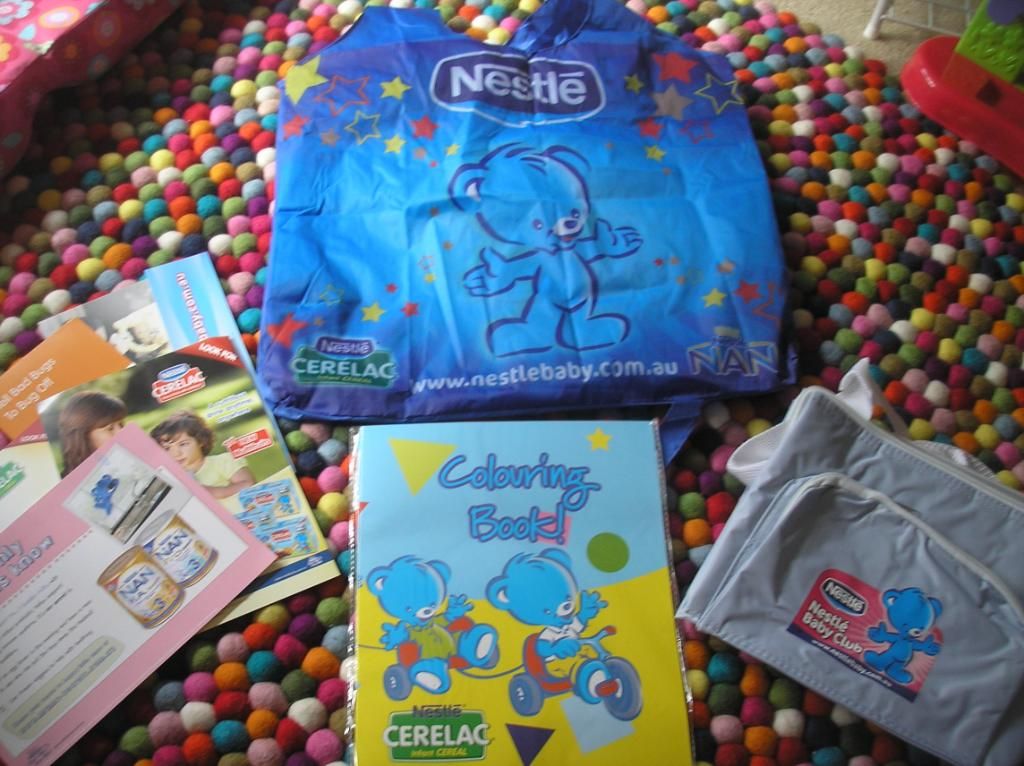
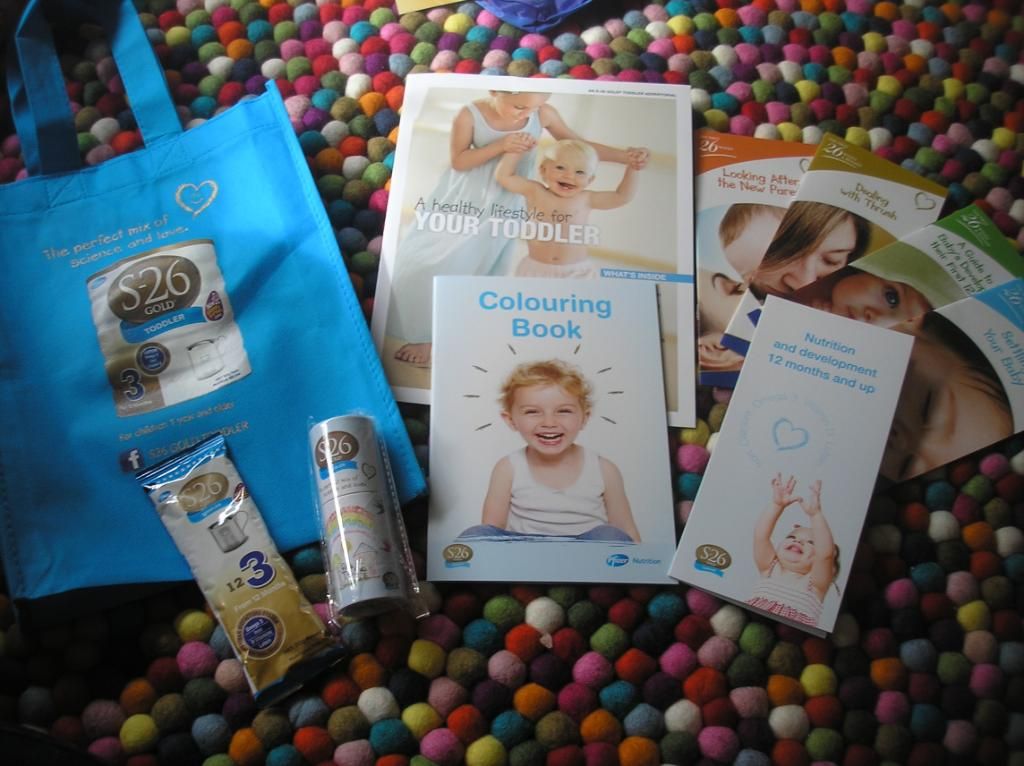
Here are the 'generous' gifts they showered me with.
From Nestle:
- A branded reusable bag (branded with the 'baby club')
- A branded colouring book
- A branded cooler bag
- A whole stash of 'advice' leaflets.
Nestle
From Wyeth
- a branded reuseable bag
- a branded colouring book
- a pack of branded crayons in a branded colouring tube
- a sample of toddler formula
- more 'advice' pamphlets
Wyeth
These 'free gifts' are full of practical, useful items and are covered in logos. Have a look at the colouring books. The Wyeth one has the S26 logo on the bottom of every page, and the pictures on the Nestle one are actually pictures of the blue bear logo doing things!
See how the logo is on each and every crayon, too?
Everything item in these bags - and the bags themselves - are designed to be used. These were given out at a baby show. Where are people who attend baby shows likely to go afterwards? Somewhere where there are other parents of small children. What's a great thing to keep small children busy? Colouring books. With crayons in a super useful travel tube. All with 'S26 Gold Toddler' written on them. The more you see something, the more normal it becomes.
The cooler bag from Nestle is one of my 'favourites'. Just like branded scale mats and branded breast pads, a cool bag is perhaps one of the worst items which could be branded by a formula company. When is it likely that a parent would be packing a cool bag which is the perfect size for a day's worth of bottles? Possibly when the child is heading off to day care, which is likely to coincide with Mum's return to work. Continuing breastfeeding while working is almost always possible at least in part, but depending on your circumstances it can be anything from super easy to really. damn. hard. So when things get tough and you're packing bottle for day care and you're stressed about if you'll have time to pump at lunch time and if you've recharged the pump batteries, there's the friendly little blue bear there on the cool bag as a reminder.
Yes, these packs did contain lots of advice saying how breast is best and that the WHO recommends exclusive breastfeeding for six months and that you should talk to your health professional before using infant formula. Well, some of it did. The stuff that has to, that is.
Firstly, if you look closely, you will see that the logos are either for a baby club, or for the toddler formula. As I said above, advertising of infant formula is not allowed, but toddler formula is. The toddler formula logos look very similar to the infant (0 - 6 month) and follow on (6 - 12 month) formula logos, which is very intentional. By advertising the almost-identical logos of toddler formula, then there is recognition of the advertising-prohibited logos at the point of sale. Toddler formula has no extra nutrition that a child couldn't get from a cup of full cream cows' milk and a multivitamin (which would be much cheaper) but it's the advertising loophole that it exists to jump through.
The other logo that you see a lot is the baby club. This is linked to the 'advice' pamphlets too. These are dangerous for two reasons. Firstly, they are dangerous because it promotes the idea that these companies have babies' health as a priority. (If this was the case, then why do they not follow the guidelines to protect their health which they know aren't enforced under law?) Secondly, 'information services' such as baby clubs, pamphlets and help lines are clearly and specifically defined as marketing.
"Marketing" means product promotion, distribution, selling, advertising, product public relations, and information services. Article 3 International Code of Marketing of Breast-milk Substitutes
Now, I did have to give the formula companies something in order to get my 'free' gifts. My all important email address, and the ages of my children/ estimated due dates. I needed to answer a whole series of questions about my baby - none of the nappy companies wanted to know any of that before they gave me their samples. They wanted all that information so that they can fill my inbox with age appropriate 'advice' - which can be timed to when things are probably going bad.
You'll notice that I said above that they only had the 'breast is best' spiel when they had to? Despite the fact that breastfeeding is recommened until two years and beyond, there is no mention of the 'breast is best' stuff on the sample of S26 Gold Toddler in my goodie bag. (And yes, giving out samples is against the WHO Code, too.) If Wyeth really thought that 'breastmilk is best for your baby' then why aren't they saying that on a sample for babies over 12 months - because the law doesn't make them.
So why did I get the bags? Well, to be honest, I wanted to share these unethical practises with my blog readers to expose them. I knew very well what would happen if I went into the baby expo. What will I do with the stuff? As much as I hate throwing useable things away since it's wasteful, I used the perfect- condition bags as bin liners; the garbage truck will pick them up in the morning. The Nestle colouring book and all the 'advice' marketing got tossed too. The crayons I've kept since I do love the tube - I'll see if I can cover it over somehow? The cool bag is actually the perfect size for Chubs' lunchbox (not the one I send her to daycare with, but the sections one that she eats from throughout the day if we're out and about.) It's really good quality too, so I'm going to see if I can cover the logo up somehow. The S26 sample? I'll mix it up and give it to Chubs one day instead of the soy milk or cows' milk she would have had otherwise, maybe on her breakfast cereal - but I can assure you that I won't be buying a tin any time soon.
Do I expect to change the world by whinging about a few sample bags? Well, like anything, probaby not. But if it makes a few more people aware of the sneakiness that goes on and to look at these giveaways a little more cynically and with a little more caution, well you know wht they say. They ones who are crazy enough to think that they can change the world are the ones who sometimes do.
I had a reply from the CEO of the chemist chain about the formula company branded mats on the baby scales. If you haven't been following the saga, you can catch the previous installments one, two and three. I would again like to point out that this is not an 'anti formula' or 'breast is best' post. I am not making comment on a parent's choice as to how to feed his or her child. This is about exposing the dirty advertising tricks of formula companies and about refusing to stay silent when pharmacies and formula manufacturers work together to put sales and profits ahead of infant health. For more on the advertising techniques of formula companies (which in many ways are similar to those of cigarette companies) see this link.
The reply which I received last week from the CEO of the company - if I'm getting replies from the CEO (or at least from his email account) then someone must be paying attention. To be honest I thought I would get a generic response which is sent to all the crazy people who bang on about the WHO Code.
Here's the reply I received:
Hello Bugs,
My team has raised your concerns with me in an effort to further examine the substance of your query. Please be assured that we welcome all feedback. Further, we use this feedback to review our offer and to look for alternate, improved ways of delivering a superior and personal pharmacy experience. This is in line with one of **** Chemists' guiding principles, 'there is always a better way'.
You have raised some important and valid points. Upon reading the correspondence between yourself and my team I can appreciate and understand your position. I would like to take this chance to explain to you, ours.
**** Chemists has a more than 50 year history in pharmacy. However, we recognise that history counts for very little unless we continue to offer the attentive, professional and friendly service and trusted pharmacists' advice for which we are known. We must do this in a way which exceeds the needs of our customers who both demand, and deserve to be valued. We pride ourselves on our track record for achieving these goals and our reputation for excellence in setting standards for service and contributing to a professional and dynamic pharmacy industry. In doing so we recognise that merely meeting minimum requirements is often not good enough. We strive for best-practice. I acknowledge the intentions of the World Health Organisation's International Code of Marketing of Breast-milk Substitutes and understand the guidelines it contains.
In particular I note section 6.8 "Equipment and materials, in addition to those referred to in Article 4.3, donated to a health care system may bear a company's name or logo, but should not refer to any proprietary product within the scope of this Code,".
The International Code of Marketing of Breast-Milk Substitutes does not counsel against use of formula company logos or branding per se. Some exceptions, as outlined above, are provided for within the Code, which is quite clear both in terms of its provisions and its intent. Our understanding is that use of our hygiene mats do not breach of the provisions or intent of the Code. In addition, the disposable hygiene mats provided for use through ****** Chemists' baby weigh service do not carry formula company logos, rather they carry logos for two baby clubs. On the basis of our assessment we will continue to offer free hygiene mats for the convenience of parents and carers who use the ***Chemists baby weigh service.
We do appreciate that your position appears markedly different to ours. At all times we seek to resolve any issues that may arise to the satisfaction of all concerned. As I said we encourage feedback in the spirit of, "there's always a better way," however in this case, I'm not sure that this is the case. We appreciate your position, and hope that you may be able to appreciate ours - however different the two may be.
If you have any further concerns, or if your complaint is made on the basis of another WHO Code and you would like to discuss this further please feel free to contact me on **phone number***
Sincerely
CEO of chemist chain
You'll notice that he skirts around the issue as to if the chemist chain plans to follow the WHO Code or not. After you get through all of the introductory lip service to going above and beyong and striving for best practice (without actually doing so), you get to the actual argument. First he defends the use of the branded mats saying that it falls within the Code (which it doesn't, see my reply below). Secondly he says that it's not really a breach since the logo is for a baby club, not the formula company. Thirdly he goes on to say that we appear to have 'markedly different' views on the matter - without actually saying how we are different. If the chemist chain is working within the WHO Code, then in what ways are our views different?
Here is my reply:
Dear CEO of chemist chain,
Thank you for your detailed reply to my email; I appreciate the time that you have taken to consider my concerns. I have responded by email rather than by phone as requested as I feel it is preferable for this conversation to be in writing for the clarity of all parties.
The section of the International Code of Marketing of Breastmilk Substitutes (the Code) that you quoted does not apply to the situation at hand.
Article 3 of the Code clearly defines a retail pharmacy as a ‘distributor’ not as a ‘health care system’, therefore sections 4.3 and 6.8 do not apply. “"Health care system" means governmental, nongovernmental or private institutions or organizations engaged, directly or indirectly, in health care for mothers, infants and pregnant women; and nurseries or child-care institutions. It also includes health workers in private practice. For the purposes of this Code, the health care system does not include pharmacies or other established sales outlets.”
The part of the Code that is being breached by the scale sheets is Section 5.5 which states that infant formula manufacturer’s “Marketing personnel, in their business capacity, not seek direct or indirect contact of any kind with pregnant women or with mothers of infants and young children.“ Article 3 of the Code includes “information services” in its definition of marketing, therefore a baby club is marketing directly to parents and the general public. Thus the advertisement of Baby Clubs run by infant formula manufacturers is in breach of section 5.5 of the Code. By creating and using the branded scale sheets, ****** Chemists is enabling the formula company to seek direct contact with mothers of infants. As stated in the advertising material of this club mothers are encouraged to join the baby clubs if they are ‘looking for advice, reassurance or just have a question’ when they use the baby weigh service.
I quote from your email, ‘In doing so we recognise that merely meeting minimum requirements is often not good enough. We strive for best-practice.’ If this is the case, then why does *** Chemists not follow the WHO Code? In the same paragraph you said that you understand the WHO Code guidelines. If this is the case, then why have you defended the use of the branded mats under sections of the code which do not apply to pharmacies? I can only assume that the way you referred to sections 4.3 and 6.8 means that either you do not understand the WHO Code as you claimed, or that you are trying to mislead me by quoting irrelevant sections of the WHO Code.
You mention that we appear to have different positions on this issue and you have said you intended to explain to me your position. However, it is still unclear to me what your position is, specifically if **** Chemists is willing to work within the WHO Code or not. Your letter explained to me that you thought that ***** Chemists was working within the Code. If this was the case (although it is not because as I explained above the section that you quoted to me does not apply to retail pharmacies) then in what ways do we have ‘markedly different’ positions? To clarify if we have different positions or not: I believe that the WHO Code should be followed. Does **** Chemists believe that The International Code of Marketing of Breast-Milk Substitutes should be followed, or not? If not, then please explain why not.
Thank you again for your time in considering my email.
- 8 ply yarn in three colours.
- 6 mm knitting needles
- yarn needle to weave in ends, scissors to cut yarn.
Skills and difficulty
Beginner knitter
- cast on
- cast off
- knit stitch
- changing colour at the end of row
- carrying unused yarn up the side
Colours
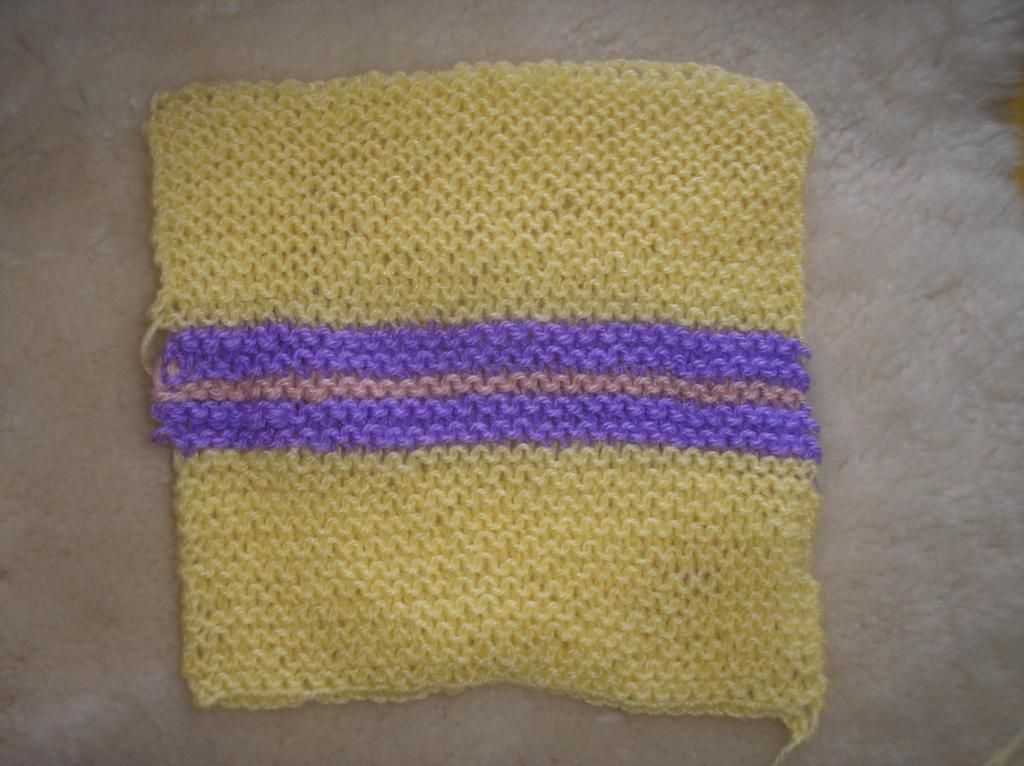
In this example, C1 is pale yellow, C2 is purple and C3 is pink
Procedure
1. Using C1, cast on 32 stitches.
2. Knit 22 rows (11 ridges). End C1.
3. Change to C2. Knit 4 rows (2 ridges). Carry unused yarn
4. Change to C3. Knit 2 rows (1 ridge). End C3.
5. Return to C2. Knit 4 rows (2 ridges). End C2.
6. Change to C1. Knit 23 rows (12 ridges).
7. Cast off and leave a 50cm tail.
8. Weave in beginning end and butterfly the tail.
Return to all the KASAD posts
WHO Code Pharmacy issue
I blogged previously about the importance of the WHO Code and about the breach at our local pharmacy. Here is the response I received. .... Chemists is proud to be able to offer our customers the opportunity to use scales for the weighing of babies in our stores. It is a service which we extend to all mums and carers and one which has been warmly welcomed by those who use it.
We believe in the ability of parents to make decisions which take account of their individual circumstances and we support the choices they make in the interests of good health.
As a retail pharmacy we provide products and services to meet a diverse range of needs. In the interests of hygiene we provide disposable covers for the convenience of the parents and carers who use the baby weigh service.
We take your concerns very seriously and as such have reviewed our position. We understand that the provision of these disposable covers does not contravene existing rules and regulations which impact pharmacy in Australia.
We are also working with our ... Chemists branch store to address this however if you have any further concerns we encourage you to please raise these directly with us at ...Management.
Kind Regards,
Operations Admin
... Chemists Customer Service
I also received a reponse from the local store. In it the manager let me know that the baby nurse was at the store once a week, with the exception of public holidays when the store was closed. I was in error when I said that there was no baby nurse there. The previous nurse had left and I hadn't realised that the new nurse was coming in on a different day, since that's one of my work days so I'm not in the pharmacy and I overlooked the signs. Despite my mistake here, however, the pharmacy is still not following the WHO Code even if the nurse was there during all opening hours (currently she is there for half a day once a week, with the available times advertised.) The manager also let me know that she had passed on my issue to the chain management and that that process takes time and she apologised if that mean that I thought that it hadn't been addressed. (It had been approximately three weeks between when I raised the issue instore and when I send my online feedback to the chain managment.)
Here is my response to the email I quoted above.
I find it very difficult to believe that you have taken my concerns ‘very seriously’ from the rest of your email. To again clarify my position – I have no objection to the provision of the baby scales or the use of a blank/ unbranded disposable mat for hygiene purposes.
I too ‘believe in the ability of parents to make decisions which take account of their individual circumstances and we support the choices they make in the interests of good health.’ It is for this very reason that I have contacted you about this issue. If you believe this as you say, then why do you undermine this through unethical advertising? If good health is really a concern of yours, then why does *** Chemists not follow the WHO Code?
I repeat my earlier point that this is not about being ‘anti-formula’ but is about making sure that it is used, advertised and sold appropriately. I say this as a mother who uses both the baby weigh station at **** and formula and who is thankful for the availability of both. I have not found anything in your email which makes me feel that you have taken my concerns ‘very seriously’. You have defended points which I never objected to. I have no concerns about the baby scales being available – indeed, I think that it is important for a pharmacy which sells weight dependant medication to have scales available. As I said both in store and in my online feedback, I have no concerns about the use of a disposable mat in general. My concern lies with the blatant formula advertising on the disposable mat. I do not see how this branding has anything to do with hygiene. The only part of your email which address the actual issue – the branding on the mat – is where you say that it ‘does not contravene existing rules and regulations which impact pharmacy in Australia’ is incorrect. The General Assembly of the World Health Organisation adopted the Code in 1981, and as a Member State of the WHO Australia has agreed to follow the Code. Whilst the entirety of the Code is not enforced under Australian law, you are incorrect in your statement that the Code does not impact on pharmacy in Australia. In ‘the interest of good health’ is *** Chemists prepared to remove the branding from the mats in the *** store as per the WHO Code, or will **** Chemists continue to jeopardise the health of infants because the prohibition of such is not legally enforced?
I will continue to let you know of future developments.
I spoke earlier about The WHO Code which is the abbreviated name for the International Code of Marketing Breastmilk Substitutes developed in 1981. I have become involved with a breach of the Code at a local pharmacy which I would like to share here.
A few weeks ago we were at the local (chain) pharmacy buying all of the usual sick baby paraphenalia that we seem to find ourselves needing. It was with concern that I notice the following disposable mat on the baby scales.
This is clearly a breach of the WHO Code - anything with a formula company logo on it is promoting that formula, and this should not be done. (Please remember what I said in my earlier post - this is not about someone's choice to use formula, but about the unethical marketing practises of companies.) I was going to let it go but I decided not to and I asked one of the sales assistants who I could speak to about it. She said she would get the manager. I spoke with her and I said that I was concerned that the mat on the scales had a formula logo on it because it was against the WHO marketing code.
She said that they had the scales there so that people could weight their babies if they wanted to and she showed me where they could write down their baby's measurements etc. She also said that the mat thingie was there as a hygiene thing to keep the scales clean between babies. I said that I had no issue with the scales at all or using a generic disposable mat. My concern was that it was provided free by the formula companies with their logo on it, so that if someone weighed his/ her baby and they were worried about the baby's weight then the first thing they see is the formula company's logo when they lift the baby up, and that that was against the WHO marketing code.
She said that she would take it up with the chain pharmacy managment through their feedback chain. I asked if I could give her my details and be infomed about what they said, she said yes and took my email.
Two weeks later I had not heard anything so I submitted the following through the chain pharmacy's website feedback section.
I am writing to discuss a breach of the World Health Organisation's International Code of Marketing Breastmilk Substitutes in the location store.
I was quite concerned that the disposable mat on the baby scales was printed with a formula company's logos. Chemist Chain want me to believe that 'it's good to know that we're looking after your health' and I find breaches of the WHO Code very serious.
The WHO code is not 'anti-formula' but aims "to contribute to the provision of safe and adequate nutrition for infants, by the protection and promotion of breastfeeding, and by ensuring the proper use of breastmilk substitutes, when these are necessary, on the basis of adequate information and through appropriate marketing and distribution."
The use of a formula company freebie, with its logo clearly visible, on the baby scales is a clear breach of the WHO Code.
Of all of the freebies to give out from formula or pharmaceutical companies, I must point out that a disposable mat on the baby scales is perhaps one of the worst possible things that a chemist - which claims to 'provide professional advice and recommend solutions for all your health... needs' can do.
If a parent is concerned about his/ her baby's weight according to the in store scales, then s/he will lift up her baby and the first thing that is seen is the formula company logo. This is unacceptable, and a far cry from the detailed professional advice which Chemist Chain claims to provide. A number on the scales does not mean much on its own, and needs to be looked at in comparison to other weight gains over a period of time, other measurements of the baby such as birth weight, prematurity, height, age and any underlying health issues. In addition, the baby's general level of health, (de)hydration as indicated by wet nappies and other indicators need to be considered. These are the questions which a suitably qualified health professional will ask before recommending (or not) formula use and any particular brand. The recommendation to use Brandname formula by Chemist Chain by placing their logo on the baby scales is in total contradiction to your stated claim of caring about the health of your customers.
There has been no in store baby nurse at the location branch for months, and even when she was there she was only there for a few hours one day a week. Since I first saw the formula branded mat on the scales a few weeks ago it has been there every time I have gone into the store.
On Date I noticed the branded mat on the scales. Whilst in the store I asked one of the sales assistants who I could discuss this breach with, and I was directed to the manager. I shared my concerns with her and she replied that the scales were there so that parents could weight their children and write their weights down, and that the mat was there for hygiene purposes. I said to her that I had no concerns about the scales or the use of a blank mat, but my concern was the formula branded mat as it was a breach of the WHO Code. She said to me that she would need to speak with Chemist Chain management and would get back to me. I gave her my email address but have not heard anything further.
Can you please let me know 1) if Chemist Chain feel that jeopardising infant health by breaching of the WHO Code is an acceptable practise, 2) what is being done about the formula branded mats in the location store and 3) why I have not been contacted by the location store with regards to my initial inquiry?
I received an automated response from the chemist chain thanking me for me feedback and saying that I could receive a reply within three working days. I then received another email thanking me again for my feedback and saying that I would be contacted by the relevant department soon.
The pharmacy is operating within the law. The breache of the Code which I have observed are not legally enforced in Australia. I await their response.
- 6 mm knitting needles
- yarn needle to weave in ends, scissors to cut yarn.
Skills and difficulty
Beginner knitter
- cast on
- cast off
- knit stitch
- changing colour at the end of row
Colours
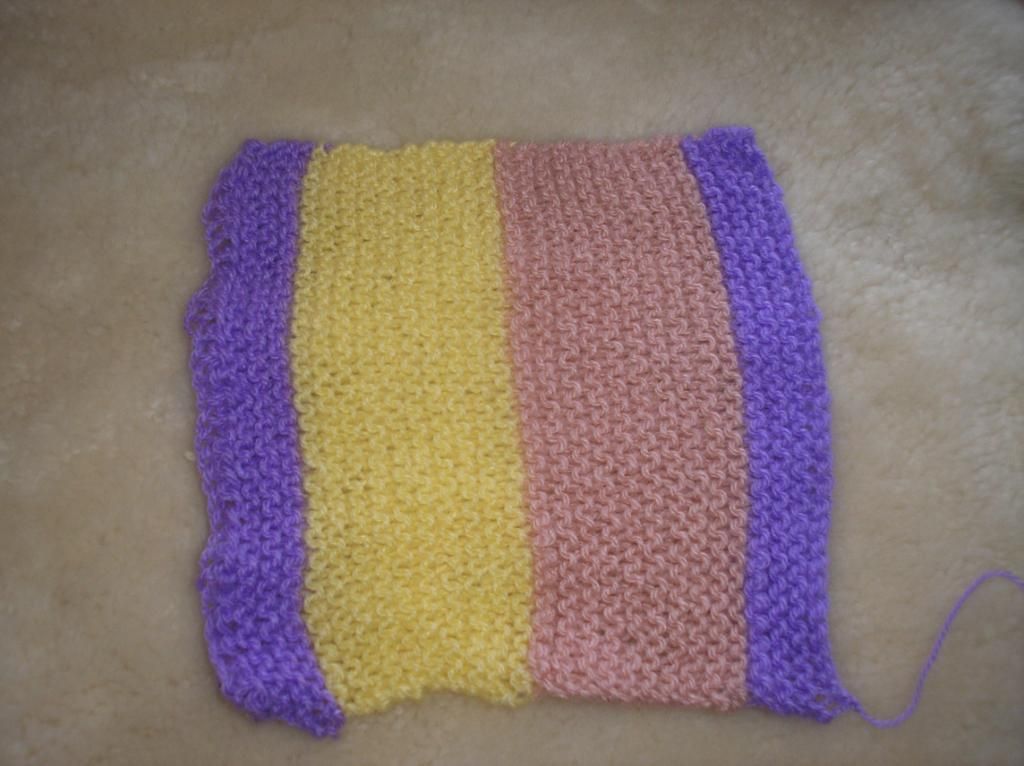
In this example, C1 is purple, C2 is yellow and C3 is pink.
Procedure
1. Using C1, cast on 32 stitches.
2. Knit 8 rows (4 ridges) End C1.
3. Knit 20 rows (10 ridges) of C2. End C2.
4. Knit 20 rows (10 ridge) of C3. End C3.
5. Repeat step 2.
6. Cast off and leave a 50cm tail.
7. Weave in beginning end and butterfly the tail.
The first part of this post is devoted to discussing the World Health Organisation's International Code of Marketing Breastmilk Substitutes. It aims to contribute to the provision of safe and adequate nutrition for infants, by the protection and promotion of breastfeeding, and by ensuring the proper use of breastmilk substitutes, when these are necessary, on the basis of adequate information and through appropriate marketing and distribution. It was adopted in 1981.
It is important to note that the WHO Code is not 'anti-formula' but is about ensuring that companies should not use unethical marketing practises to sell more formula or other products and in so doing jeopardising infant health.
I would like to take this opportunity to point out to my readers that this is not an 'anti- formula' post, not am I trying to make a judgement on any parent's feeding choices. Indeed, I think that freedom of choice is very important for parents - please don't think that I am saying anything about if you should or shouldn't use formula or dummies or how feeding choice determines if you are a 'good mother' - whatever that means. What this post is about it about exposing the dodgy marketing practises which are used to increase profits - both for formula companies and for chemists.
Many of the advertising techniques which are used by formula companies are unethical, deceptive and endanger health to increase profits. If this was a blog post about the dodgy marketing strategies of tobacco companies, then people would be calling for action to prevent this. Please keep this in mind while following this story - it is about holding large companies responsible for their dishonest methods, not about feeding choice. Breastmilk substitute marketing is even more complex that tobacco advertising, because it deals with a legitimate, needed and life saving (in some cases) product, which enable the companies to get away with much more, to the detriment of our children's health.
The WHO Code covers formula, but also bottles, dummies and solid food (when replacing breastmilk). it is quite comprehensive but, in my opinion, it tells manufactures and retailers to 'play nice' when it comes to advertising. Formula should not be claimed or implied as to be superior or equivalent to breastmilk and there should not be formula advertising to the general public - including toddler formula. Health facilities and health professionals should not promote or recommend a particular formula brand and free samples of formula or items that promote breastmilk substitutes (eg a freebie toy, blankie, pen or changemat with a formula logo should not be provided to pregnant women, new mothers, or health facilities. Pictures or text that idealise the use of breastmilk substitutes should not be used - this includes using a 'shield' logo which implies protection, or made up non-words like 'immunocare' and 'prebiotics'.
I note that many of these measures also apply to medication and cigarettes. There are many rules about the advertising of prescription medication - for example in Australia it cannot be advertised to the general public. This does not mean that the medication is bad, or that it shouldn't be used, or that you are a bad person if you take the medication, but that direct advertising may convince people to take it who don't need to which may place them at risk.
I must admit, I once felt sceptical about these advertising rules. If the product isn't bad, then why is advertising it bad? It was once explained to me using this analogy.
The marketing regulation is in response to a real problem ie babies dying because of the advertising of infant formula and feeding bottles, it is in response to the UNNECESSARY and INAPPROPRIATE use of these products. If advertising and marketing of infant formula did not result in the unnecessary and inappropriate use of infant formula and feeding bottles then there would be no need for marketing to be regulated. I'll try to develop an example (and this will not be perfect so please forgive- it is an extreme example)...another product that can be useful and necessary in some situations is a urinary catheter. It is used when people have surgery, when they have various medical conditions and in the past even by astronauts (I think!) but there could be a wider market....they could be sold to long haul truck drivers or to people who find it difficult to drag themselves away from the TV or game console for toilet breaks, others who just find it more convenient. Most I would think would say that such usage is inappropriate and potentially dangerous. I think however, that should there be a situation where urinary catheters were marketed for such purposes and the marketing worked (ie people were using them) that it would be reasonable for such marketing to be banned because it was harming people. This not because there is anything wrong with the product itself but because the climate that was created by the marketing had made any marketing harmful. That's what happens with bottles....and bottles are so ingrained all over the world that they are a universally accepted symbol for babies.
The WHO Code is not in itself legally enforceable, and this is the problem. Some of it has been prohibited under legislation in Australia, particularly the MAIF agreement. For more information see here. However, this is not sufficient and the government's failure to enforce the entirety of The WHO Code.
In my next post I will give details of a breach of The WHO Code at my local pharmacy, why I'm concerned about it and what I am doing to change it.
- 8 ply yarn in three colours.
- 6 mm knitting needles
- yarn needle to weave in ends, scissors to cut yarn.
Skills and difficulty
Beginner knitter
- cast on
- cast off
- knit stitch
- changing colour at the end of row
Colours
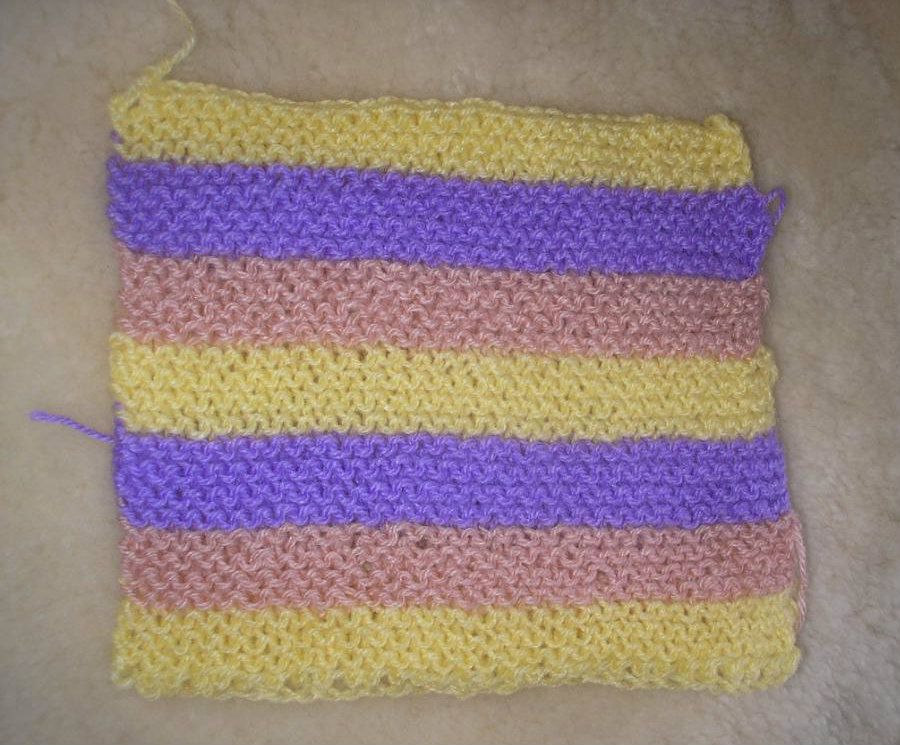
In this example, C1 is pale yellow, C2 is pink and C3 is purple.
Procedure
1. Using C1, cast on 32 stitches.
2. Knit 8 rows (4 ridges) End C1.
3. Knit 8 rows (4 ridge) of C2. End C2.
4. Knit 8 rows (4 ridge) of C3. End C3.
5. Repeat steps 2, 3 and 4.
6. Repeat step 2.
7. Cast off and leave a 50cm tail.
8. Weave in beginning end and butterfly the tail.